Children's rights in India Despite
Constitutional guarantees of opportunity and civil rights, millions of children
face wide-spread deprivation and discrimination. A large part of this stems from
being seen hrough the lens of adults who make decisions for them, and who prefer
to address their welfare rather than their rights, says Enakshi
Ganguly Thukral.

Combat Law, Vol. 3, Issue 1 - Every time my 16-year old daughter gets on to stage to dance, she dusts some extremely fine shiny stuff on her face and it glitters and shines. By the time she is off the stage, most of the shiny glitter is gone, except for some bits of sparkle here and there, and by the next morning there is no trace of it. India's shine is much like that - here today, gone tomorrow - effervescent and transient.
Combat Law, Vol. 3, Issue 1 - Every time my 16-year old daughter gets on to stage to dance, she dusts some extremely fine shiny stuff on her face and it glitters and shines. By the time she is off the stage, most of the shiny glitter is gone, except for some bits of sparkle here and there, and by the next morning there is no trace of it. India's shine is much like that - here today, gone tomorrow - effervescent and transient.
Every day we see articles focusing on the shining and the
non-shining `bits' of India. But if anything or anyone truly shines in India
today, it is her children, comprising over one fourth of our population.
Resilient and lively, they continue to smile and give hope in the not so shining
bits of India that most of them inhabit. But then, they are not voters. What
they think or feel does not count.
Indians constitute 16 per cent of the world's population,
occupying 2.42 percent of its land area. India has more working children than
any other nation, as also among the lowest female-male ratios. Despite
Constitutional guarantees of civil rights, children face discrimination on the
basis of caste, religion, ethnicity and religion. Even the basic need for birth
registration that will assure them a nationality and identity remains
unaddressed, affecting children's rights to basic services.
India is also home to one of the largest illiterate citizenries
in the world. In the not so shining India we see, hear and read of, children are
dying of starvation, while food in our granaries rots and feeds rats. We watch
while the female sex ratio dips. Little children, barely able to stand, are
married off flouting all laws. Little ones are sacrificed, trafficked and sold;
as others are locked, abused, sodomised - the list is endless. And there are all
those realities that never make the news. We know this is only the tip of the
iceberg, but we choose not to act. Our silence and tolerance not only condones
such violation of rights, it also makes us guilty of complicity.
Therefore, any understanding of human rights of children cannot
be confined to some children - 'poor children', 'working children' and
'marginalised children'. Such categories only help us to remove ourselves from
the problem. Let us not delude ourselves. Violations of children's rights are
not limited to the poor and downtrodden. They happen in middle class and elite
homes too, albeit in different forms, and the silence around these is even
deeper. Also, any analysis on the situation of children must be understood
within the context of the economic and political changes in the country. Of
particular importance are globalisation and liberalisation, and the gender,
caste and religious attitudes that prevail today. All these add to children's
vulnerability and affect any action that may be taken for them.
|

Children are not a homogeneous category. Like adults, they are
divided into different categories based on social and economic status, physical
and mental ability, geographical location etc. These differences determine the
difference in the degree of their vulnerability. While gender discrimination
exists almost all over the world, it is much greater in some countries - and
India is definitely one of them. Girls in vulnerable situations such as poverty,
disability, homelessness etc. find themselves doubly disadvantaged, by their
gender and the physical, economic, political, social situation that they find
themselves in. It is therefore imperative to take a gender perspective into
account in examining the situation of children.
The Rights vs. Welfarist approach
The Constitution of India provides a comprehensive
understanding of child rights. A fairly comprehensive legal regime exists for
their implementation. India is also signatory to several international legal
instruments including the Convention of the Rights of the Child (CRC). However,
the government seems to be more comfortable with the idea of well-being rather
than rights (with its political overtones). Child rights activists are faced
with challenges of promoting and protecting rights as a positive social value.
Needless to say, ours is not the only government to do so. The
Union Government's ideology resonates with the watering down of the rights based
framework in the recent UN Special Session on Children which failed to reaffirm
international pledges made in 1990 to protect the rights of children.
The government's approach remains largely welfarist. India is
yet to adopt a single comprehensive code that addresses the provisions of the
CRC. Clearly the draft National Policy (Charter) for Children which has been
recently passed in parliament, and is envisaged as being such a code, is
inadequate as it does not address the full range of rights. It does not make any
reference to the CRC. In the words of the Joint Secretary Department of Women
and Child, GOI, it captures the 'essence of the CRC' thereby does not need to
refer to it!
Child Rights - From an adult's perspective
An examination of the laws shows that although they are meant
to protect the interests of children, they have been formulated from the point
of view of adults and not children. They are neither child-centred, nor child
friendly, nor do they always resonate with the CRC.
The problem begins with the very definition of 'child' within
the Indian legal and policy framework. The CRC defines children as persons below
the age of 18 years, however different laws stipulate different cut-off ages to
define a child. Only the Juvenile Justice (Care and Protection) Act 2000 is in
consonance with the Convention. In the absence of a clear definition of a child,
it is left to various laws and interpretations.
|
That our laws are not child friendly or child oriented is
also evident in the distinction family laws make between legitimate and
illegitimate children depending on the status of their parents' marriage or
relationship. A child born out of wedlock or of a void or illegal marriage is
considered 'illegitimate'. Children pay for the decisions taken by the parents
and are denied inheritance rights. Even worse, a child born of rape is
stigmatised and treated as 'illegitimate', both by society and law.
Access to health - A chimera
The health of our children continues to be a matter of grave
concern, especially in the wake of growing privatisation of health services, and
their increasing inaccessibility for the poor. This is a particularly serious
situation as environmental degradation and pollution lead to a further
deterioration in children's health. The working conditions that many children
are forced to suffer worsens matters.
In our shining India, children suffer from malnutrition or die
of starvation and preventable diseases. According to UNAIDS there are 170,000
children infected by HIV/AIDS in India. Children affected by the virus-whether
children of victims or those who are infected themselves-- live on the fringes
of society, ostracised by people they call their own, unloved and uncared for,
even as our government continues to squabble over numbers of affected people.
Even juvenile diabetes is reported to be taking on pandemic proportions.
While the Constitution lays down the duties of the State with
respect to health care, there is no law addressing the issue of public health.
Children's health care needs continue to be in great part dealt under the
Reproductive and Child Health Programme of the Ministry of Health and Family
Welfare, with a focus on reproductive health and safe motherhood and child
survival. The other health needs of children are addressed by the country's
primary health care system; with very little attempt to address these needs
specifically or separately.
The population policy with its coercive manifestations in the
states has of course proved most 'children unfriendly'. Parents aspiring to
political positions are now forced to choose between children and politics. Law
does not allow persons with more than two children to hold elected positions in
local self governments-and many choose politics as they disown their children or
give them up for 'adoption' in an effort to keep to the 'right' family size.
The Government has announced its National Health Policy 2000.
One cannot but note that children do not find mention as a separate category -
yet another example of the lack of child focus in our planning and
implementation.
Education for all - A promise yet to translate
Education for all is also a promise held out by the state. An
examination of State policies and programmes shows that education is not going
to open the promised gateway to equality. Indeed if anything, it is a promise of
'differential education for all' (read 'some' even here). While some children
continue to have access to mainstream schools or expensive private schools, the
rest must contend with 'non-formal' second grade education provided by untrained
and lowly paid 'para- teachers'. As if that was not enough, the new curriculum
framework has opened up a can of worms on the kind of biased syllabus, with
incorrect or incomplete content, that our children will be subjected to.
The passing of the 93rd Amendment Bill (passed as the 86th
Amendment to the Constitution) making education a fundamental right, should have
been an occasion to rejoice. Instead it has become an issue for another long
struggle because it only reinforces the lack of political will to make education
universal and accessible for all. By leaving out those in the critical 0-6 years
age group, putting the onus of creating conditions on parents for sending
children to school and making it their fundamental duty, by reinforcing parallel
streams of education, the amendment has once again sealed the fate of poor and
marginalised children.
Although the rhetoric speaks of free and compulsory education
for all, in practice, the education system seems to be designed to keep children
out of it. To implement the 86th Amendment, the government has drafted 'The Free
and Compulsory Education Bill, 2003. Concerns and criticisms on this bill are
being expressed by educationists and activists.
|
Beatings, abuse, physical and mental torture faced by the
students in schools is one of the reasons for the high dropout rate. It is well
established that corporal punishment is detrimental to children's growth and
development. It is in violation of their rights. But there is no comprehensive
national law banning it, although several states have even enacted laws dealing
with it. Moreover the National Education Policy, 1992 clearly states that
corporal punishment should be firmly excluded from the education system. Despite
that, however, there are several cases that have been registered against
teachers in schools for use of violence.
At a recent workshop attended by children from across the
country was a young spastic child named Debu.
- I have a right to be called by my name. Why is it that all children are called by their names and I am called langda (lame) or even pagal (mad)?
This made all the other children sit up and look at Debu in a
new light. While they had been discussing their rights, it had not occurred to
them that children with disabilities may be denied even this basic right.
Children with disability continue to suffer unequal opportunities for survival
and development. They are denied personal or economic security, health care,
education and all basic needs necessary for their growth. Further certain
disabilities, such as, for example mental disability carry even greater stigma.
And if the disabled child is a girl, then the discrimination is doubled. The
rights of disabled persons has finally been recognised with the enactment of the
Persons With Disabilities (Equal Protection of Rights and Full Participation)
Act, 1995.
Children in situations of crime and exploitation
Recognising the flaws of the 1986 Juvenile Justice Act, the
government passed the Juvenile Justice (Care and Protection) Act, 2000. But the
knee jerk reaction in amending the law without a wider discussion and
consultation with child rights practitioners, has left many who are concerned
with children and work with them deeply distressed. In 2003 the government
drafted amendments to the law. But, because of criticisms and concerns raised by
several organisations and groups, it has been placed before a Parliamentary
Standing Committee. The Committee is currently reviewing the law.
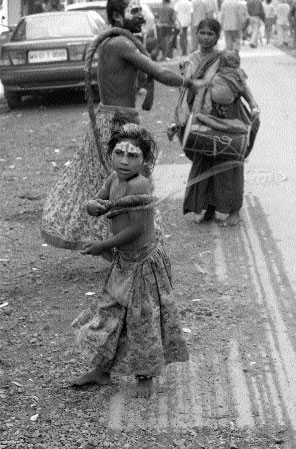 The Child Labour
(Prohibition and Regulation Act) was enacted in 1986, to specifically address
the situation of children in labour. However,
this law distinguishes between hazardous and non-hazardous forms of labour, and
identifies certain processes and occupations from which children are prohibited
from working. It leaves out a large range of activities that children are
engaged in and are exploited and abused. The large-scale exploitation and abuse
of children employed in domestic work and hotels are cases in point.
The Child Labour
(Prohibition and Regulation Act) was enacted in 1986, to specifically address
the situation of children in labour. However,
this law distinguishes between hazardous and non-hazardous forms of labour, and
identifies certain processes and occupations from which children are prohibited
from working. It leaves out a large range of activities that children are
engaged in and are exploited and abused. The large-scale exploitation and abuse
of children employed in domestic work and hotels are cases in point.
Child trafficking is one of the most heinous manifestations of
violence against children. This is taking on alarming proportions - nationally
and internationally. Although, very little reliable data or documentation is
available, meetings and consultations across the country have revealed the
gravity and the extent of this crime. It is high time we understood and realised
that children are trafficked for a number of reasons and this cannot be treated
synonymously with prostitution. The absence of this comprehensive understanding
and a comprehensive law that addresses all forms of trafficking to back it makes
this issue even more critical.
Adoption: The need for greater checks and balances
Adoption is one of the best and appropriate forms of
alternative family care. Indeed, it is the only way to break the mindset of
institutional care for children, which has been posed as the only solution for
many years.
However, adoption of children continues to be determined by
religion of the adoptive parents or the child when religion is known. Only
Hindus, Jains, Buddhists and Sikhs can adopt children. The personal laws of
other religions - Muslims, Parsis, and Jews do not allow it. Even as it exists
for Hindus, the law has serious flaws discriminating against married women. It
allows only married men to adopt. Further, it only allows for adoption of
children of opposite genders.
The Juvenile Justice (Care and Protection of Children) Act,
2000 also provides for adoption making no exception on the basis of religion. So
more complications may arise. Besides, the large scale setting up of baby shops
and the selling of babies from poor families has caused panic across the
country. We need to be careful not to throw the baby out with the bath water.
Greater checks and balances are required to ensure that adoption is legal and
proper, and that it is not being used as a means of trafficking of children.
Protection from, or by, instruments of violence?
In January 2002, a school going girl in Jammu, while discussing
the Right to Protection said that even in the current environment of unrest she
felt protected because she had armed guards, who accompanied her to school! She
was not alone. There were others too who felt protected because they had guards.
Incidentally, one of them was from the Kaluchak Army School in an army base,
which was attacked by terrorists a month later. We need to ask ourselves what
environment are we providing to our children where they need instruments of
violence to feel protected?
|
Armed conflicts across the country, based on religion,
ethnicity, and caste have affected the lives of children everywhere. The recent
violence in Gujarat is still fresh in all our minds. Children continue to suffer
from the conflict that Punjab faced in the last decade. The ongoing situation in
Kashmir and in many of the North Eastern States has led to many child
casualties. Children are both victims and perpetrators, brainwashed and incited
into following adults in spreading violence. Even as they are seen as
perpetrators of violence, they are victims of an adult worldview imposed on
young minds.
Children and disaster mitigation
Thousands of children are homeless or living in inadequate
living conditions. Thousands of others are displaced in the name of development
and progress. Land is acquired for 'public purpose', while the benefits seldom
include those who are evicted and displaced. Yet others are de-housed as a
result of natural calamities - the floods, cyclones, earthquakes that have come
to become almost a regular feature in our country. In all of these, while whole
communities are affected, children are affected even more.
An estimated 3.3 million children were affected by the
supercyclone that hit the coastal districts of Orissa on October 29, 1999. But
NGOs reported that for five days after the cyclone, no special attention was
focussed on the needs of children. There was very little information on where
the children were, where they were going, or being taken.
How many children were actually displaced, how many died in the
earthquake that hit Gujarat on 26 January, 2000? No one has exact numbers. This
is true of all such situations of disaster or displacement. The need is to
ensure that along with immediate relief measures, proper information is
collected so that we can get a sense of the numbers affected, and ensure that
children are helped to move back to a semblance of normalcy as soon as possible.
This is to ensure that there are no long-term psychological implications. In the
absence of a holistic disaster mitigation policy, which is also designed to be
child friendly, this will not be possible. The same is true for rehabilitation
policies for development- related displacement.
Child participation: Many miles to go
It is only with the ratifying of the Child Rights Convention
that children's rights to participation began gaining formal recognition,
although several NGOs had initiated processes to enlist participation of
children and young adults long before the CRC. There is, however, no universal
or accepted definition of child participation. Various groups and individuals
have defined it according to their own understanding. There is still a fairly
long journey before this 'inclusion' of children's participation is internalised
and accepted widely.
Is the situation confronting the lives of our children bleak,
or is there reason for hope? Can we promise them an India that truly shines?
What do elections hold for these non-voters? Lest we forget, they are the adults
of tomorrow, and they willhold the adults of today accountable someday.
Enakshi Ganguly Thukral
Combat Law, Volume 3, Issue 1
April-May 2004
Combat Law, Volume 3, Issue 1
April-May 2004
Enakshi Ganguly Thukral works with HAQ: Centre for Child
Rights. HAQ is dedicated to the recognition , promotion and protection of all
children.
___________________________
The History of Child Rights in India
 |
| © UNICEF/India/2007 |
| The right to play is a fundamental right of the child as enshrined in the Convention on the Rights of the Child. |
The Indian Constitution has a framework within which ample provisions exist for the protection, development and welfare of children. There are a wide range of laws that guarantee children their rights and entitlements as provided in the Constitution and in the UN Convention.
It was during the 50s decade that the UN Declaration of the Rights of the Child was adopted by the UN General Assembly. This Declaration was accepted by the Government of India.
As part of the various Five Year Plans, numerous programmes have been launched by the Government aimed at providing services to children in the areas of health, nutrition and education.
In 1974, the Government of India adopted a National Policy for Children, declaring the nation's children as `supremely important assets'.
This policy lays down recommendations for a comprehensive health programme, supplementary nutrition for mothers and children, nutrition education for mothers, free and compulsory education for all children up to the age of 14, non-formal preschool education, promotion of physical education and recreational activities, special consideration for the children of weaker sections of the population like the scheduled castes and the schedule tribes, prevention of exploitation of children and special facilities for children with handicaps.
The policy provided for a National Children's Board to act as a forum to plan, review and coordinate the various services directed toward children. The Board was first set up in 1974.
The Department of Women and Child Development was set up in the Ministry of Human Resource Development in 1985. The Department, besides ICDS, implements several other programmes, undertakes advocacy and inter-sectoral monitoring catering to the needs of women and children.
In pursuance of this, the Department formulated a National Plan of Action for Children in 1992. The Government of India ratified the Convention on the Rights of the Child on 12 November 1992.
By ratifying the Convention on the Rights of the Child, the Government is obligated "to review National and State legislation and bring it in line with provisions of the Convention".
The Convention revalidates the rights guaranteed to children by the Constitution of India, and is, therefore, a powerful weapon to combat forces that deny these rights.
The Ministry of Women and Child Development has the nodal responsibility of coordinating the implementation of the Convention. Since subjects covered under the Articles of the Convention fall within the purview of various departments/ ministries of the Government, the Inter-Ministerial Committee set up in the Ministry with representatives from the concerned sections monitor the implementation of the Convention.
At the provincial level
The State Governments have to assimilate - in letter and spirit - the articles of the Convention on the Rights of the Child into their State Plans of Action for Children.
A number of schemes for the welfare and development of children have been strengthened and refined with a view to ensuring children their economic, political and social rights. The Convention has been translated into most of the regional languages for dissemination to the masses.
 |
| © UNICEF/India/2007 |
| A young girl married as per elders wishes |
The mobilisation and greater involvement of NGOs in programmes for the development of children and women has increased the potential to accelerate the development process in achieving the national goals for children, as outlined in the National Plan of Action.
Accordingly, their involvement in dissemination of information of children's rights as well as in preparation of the Country Report was considered vital by the Government.
In order to facilitate an open consultative process, a three day National Consultation Workshop was held in Delhi during December 1994 on CRC. India's first country report drawing extensively from these discussions was enriched with constructive suggestions given by the experts for full implementation of the Rights of the Child.
Subsequently, eleven state level workshops were held around the country at Jaipur, Calcutta, Lucknow, Hyderabad, Bangalore, Pune, Jabalpur, Patna, Ahmedabad, Bhubaneswar and Chandigarh in the course of 1994 to disseminate the provisions and to give an opportunity to the states to highlight their issues and make suggestions.
Most of the rights detailed in the Convention are guaranteed in the Constitution of India. Since 1950, these rights have been expanded through the process of judicial interpretation and review.
The ratification of the Convention has made efforts more coordinated and sustained. The priority areas of action identified in each section of the country report present a long and serious agenda for government, its departments, NGOs and society in general.
The Convention has added legal and moral dimensions to child's rights and the obligation to fulfill children’s basic needs. Rights can be declared, policies can be formulated, but unless the life of the child in the family and community gets improved all efforts may be meaningless.
There is a need to raise awareness and create an ethos of respecting the rights of the child in Indian society. We need to empower the younger generation to assert their basic rights in order to realize their full potential.
India’s next CRC Report is to be submitted by 10 July, 2008. This will be the combined Third & Fourth Periodic report.
The government has formed a High-Level Committee for preparing the CRC Periodic Report. This has representatives from Central Govt. Ministries, including Ministry of External Affairs, State Governments and NGOs. UNICEF is also a member of this Committee.
Ensuring that child rights are met for every child is a daunting challenge for India but also a testimony to the Government’s commitment to the cause of children.
_________________________
Child Law

Child Labour (Prohibition & Regulation) Story and Stats
Tue, 04/17/2012 - 13:16 — LIG Reporter
2 years ago I missed the Howrah bound train somehow, and me and my sister had
to travel in a general bogie out of choice.
Indian Law: Corporal Punishment to be Banned
Tue, 07/27/2010 - 03:05 — LIG Reporter
The practice of corporal punishment is often adopted
by teachers, to implement discipline, among students. Corporal punishment is an
extreme breach of children’s right to protection, besides being a form of
physical/mental violence. As per Indian law, corporal punishment amounts to
human rights violations too. According to the official report of the Ministry of
Women and Child Development, conducted in 2007, on child abuse, two out of every
three students are physically abused. Further, 73% of boys face physical
punishment as compared to 65% of girls. All of this makes children fear
teachers and become miserable in class. However, most of the students
choose to suffer silently, rather than reporting the matter to parents or to
others.
Human Rights Violations: Child Abuse in Bangladesh
Sun, 07/18/2010 - 12:51 — LIG Reporter
Children in Bangladesh are often subjected to sexual abuse and bonded labor.
However, it is difficult to track down the exact number of such human rights
violations, due to several reasons. Firstly, Bangladesh has a low rate of birth
registrations. Sexual exploitation of children occur at all levels in the
country spanning brothels, homes, workplaces, hotels and even schools.
Human Rights Violations: Child Prostitution in India
Thu, 06/24/2010 - 19:28 — LIG Reporter
In India, it is a fact that young girls, irrespective of their socio-economic
backgrounds, are at a higher risk of being sexually exploited than boys. Several
surveys conducted way back in 1987, reported that 20 percent of women
prostitutes are actually minors.
Indian Law: Right of Children to Free Education
Wed, 06/23/2010 - 06:04 — LIG Reporter
In a developing country like India, a majority of the population is
illiterate and living far below the poverty line. Inevitably, the Right of
Children to Free and Compulsory Education Act, 2009, was enforced by the Indian
government to regulate the education of children. Children related laws and
issues are of considerable interest to the government and the judiciary. Under
the Indian laws, every child is guaranteed, the right to admission, education
and the right to not be expelled from a school.
India Legal News: Central Government All Set To Amend The Juvenile Justice Law
Thu, 06/17/2010 - 15:59 — LIG Reporter
Children related laws and issues are multiplying day by day. Every time you
watch a news channel or read a newspaper that covers India legal news, there
will be a feature on children or issues relating to them. True, every child
needs care, nurturing, affection and education. These basic needs of a child
must be protected, even when a minor violates a law. The conventional norms in
India are such that it will not be possible for a child who is a suspect in any
case will be able to bounce back to normal life after going through legal
procedure in court. Be it in a family, school or in social life, the child will
be looked down upon like a criminal even if laws protect the child.
Indian Law for Juvenile Justice
Thu, 06/17/2010 - 15:49 — LIG Reporter
Many crimes are committed by children in India, so are crimes being done
against them. Children related laws and issues continue to pose serious concern
in different parts of the country. In the years 2003 - 2004, India witnessed a
rise of 7.9 percent in offences committed by minors. These offences include
arson, theft and cheating by minors who are in the age group of 16 to 18 years.
Indian law addresses the issue through the provisions of the Juvenile Justice
(Care and Protection of Children) Act, 2000. The Act was enforced in April 2001
and replaced the Juvenile Justice Act, 1986. The Act has laid down a uniform
juvenile justice system throughout India.
Indian Laws: School Curriculum Suffers as Authorized Bodies Conflict
Wed, 06/09/2010 - 19:06 — LIG Reporter
Indian laws on education don’t impress today’s smart young students. The plan
of the government is to introduce a common curriculum for Class 12 Maths and
Science. This has met with opposition from the National Council of Educational
Research and Training (NCERT). Let’s not forget, the NCERT is the body
responsible for preparing school text books and curriculum. The push for a
common curriculum for maths and science, made by the Council of School Board of
Education (COBSE), is seen as a transgression of role by the council. A letter
by Prof G Ravindra, Director NCERT, to the CBSE president states that the COBSE
does not have the right to conduct the curriculum revision exercise, since
curriculum preparation and revision has been the right and forte of NCERT since
years.
Right to Education: Kerala Moves Ahead with New Initiatives
Wed, 06/09/2010 - 18:52 — LIG Reporter
Kerala, the land of lush backwaters and high literacy rate, figures in the
news, this time, for its ‘bold moves’ in the field of education. The state
boasts a literacy rate of 90.92 percent and a dropout rate of 0.83 percent.
Socially relevant, the next three stories reflect well on Kerala. One by one,
lets understand how the right to education is translated into initiatives by the
government of Kerala.
How to Identify Types of Guardians under Hindu Law
Tue, 06/08/2010 - 18:35 — LIG Reporter
The Hindu Minority and Guardianship Act, 1956, regulate the laws pertaining
to minority and guardianship among Hindus. It extends to whole of India except
for the state of Jammu and Kashmir. Few important definitions under the Act are:
_______________________
_______________________

Centre for Child and the Law:
While engaging with this legal instrument, the Centre for Child and the Law (CCL) found the CRC to substantially expand opportunities for governments and civil society actors to address the indignities perpetrated on children. The Centre also realized the need to deepen its own understanding of the way the CRC relates to Indian realities. It celebrated the progressive vision of this treaty, especially such as a child's right to autonomy, right to participation and the fact that it incorporates both civil and political rights as well as socio-economic cultural rights of the child. These have to be internalized by us as citizens and as a nation if we are to emerge as a society, which respects the human rights of children. CCL's organizational thrust is to establish these rights of the child within the Indian context, critique and go beyond these minimum standards where possible and actively engage with State and civil society actors to realize this radical vision.
The Centre advocates the need for a more accountable and responsive State. It argues against subsistence provisions for children in public policy and the quiet acceptance that budgetary constraints are grounds for the denial of the rights of children. It believes that a society that fails to address the root and structural causes of such violations and neglects to offer them the basic protections afforded in rights discourse, is a society that has got its priorities wrong. CCL also advocates for greater societal consciousness, to create a solidarity based peoples' movement to exert pressure from below. The underlying concern is to touch the lives of children and their families and communities, while strengthening the hands of those who strive to make child rights a reality.
Position:
Objectives:
While engaging with this legal instrument, the Centre for Child and the Law (CCL) found the CRC to substantially expand opportunities for governments and civil society actors to address the indignities perpetrated on children. The Centre also realized the need to deepen its own understanding of the way the CRC relates to Indian realities. It celebrated the progressive vision of this treaty, especially such as a child's right to autonomy, right to participation and the fact that it incorporates both civil and political rights as well as socio-economic cultural rights of the child. These have to be internalized by us as citizens and as a nation if we are to emerge as a society, which respects the human rights of children. CCL's organizational thrust is to establish these rights of the child within the Indian context, critique and go beyond these minimum standards where possible and actively engage with State and civil society actors to realize this radical vision.
The Centre advocates the need for a more accountable and responsive State. It argues against subsistence provisions for children in public policy and the quiet acceptance that budgetary constraints are grounds for the denial of the rights of children. It believes that a society that fails to address the root and structural causes of such violations and neglects to offer them the basic protections afforded in rights discourse, is a society that has got its priorities wrong. CCL also advocates for greater societal consciousness, to create a solidarity based peoples' movement to exert pressure from below. The underlying concern is to touch the lives of children and their families and communities, while strengthening the hands of those who strive to make child rights a reality.
History:
The Centre for Child and the Law (CCL) was established on 1
April 1996 , in the National Law School of India University (NLSIU), Bangalore .
The idea to start a Centre was to further the vision of NLSIU to marry legal
expertise with the social sciences, and was a spin off from the preliminary work
undertaken in collaboration with UNICEF. It stemmed from a deep interest to
place issues of the child at the forefront of public policy. Shortly after, in
July 1999, the Ministry of Social Justice and Empowerment, Government of India,
conferred the Juvenile Justice Chair on NLSIU, which is occupied by Prof. Babu
Mathew the then Faculty Co-ordinator, who has played a significant role in
developing the Centre. This, along with the fact that CCL is located in a
premier and autonomous Law University, has provided it with the opportunity to
play a more strategic role in the arena of law and social change.
Despite the Centre being an extension programme of NLSIU, it has to mobilize its own resources. Initial grants and seed monies from funding agencies such as UNICEF and National Foundation for India (NFI) lent the necessary stability CCL required in the early years. To meet its infrastructural requirements, Child Relief and You (CRY) stepped in to fund the vibrant office space located on the first floor of the NLSIU building, where the Centre now operates from.
Since December 1999, having received funds from the Humanistic Institute for Co-operation with Developing Countries (HIVOS), the Centre was able to broaden its scope of work. HIVOS continues to actively support the work of CCL.
The Centre's core funding now (October 2010 to September 2012) comes from the Sir Dorabji Tata Trust(SDTT), while small short term projcts are being funded by the Karnataka State Legal Services Authority and National University of Education Planning and Administration(NUEPA).
Mission:Despite the Centre being an extension programme of NLSIU, it has to mobilize its own resources. Initial grants and seed monies from funding agencies such as UNICEF and National Foundation for India (NFI) lent the necessary stability CCL required in the early years. To meet its infrastructural requirements, Child Relief and You (CRY) stepped in to fund the vibrant office space located on the first floor of the NLSIU building, where the Centre now operates from.
Since December 1999, having received funds from the Humanistic Institute for Co-operation with Developing Countries (HIVOS), the Centre was able to broaden its scope of work. HIVOS continues to actively support the work of CCL.
The Centre's core funding now (October 2010 to September 2012) comes from the Sir Dorabji Tata Trust(SDTT), while small short term projcts are being funded by the Karnataka State Legal Services Authority and National University of Education Planning and Administration(NUEPA).
To institutionalize a child rights culture in our society that
will enable children to live with dignity and respect.
Position:
CCL believes that the State has a duty to meet the needs of
every Indian child, with priority given to the most marginalized. However, as an
actor of civil society CCL feels it has a responsibility to supplement efforts
made by the State to safeguard the interest of children and work in
constructive, critical collaboration with the state and civil society towards
realizing this common goal.
Objectives:
While building the Center the aim was to develop a space where
research focuses on building linkages between the globalization process and the
violation of child rights and which can enable the development of a South based
jurisprudence which centers around the use of education as a strategy to combat
the exploitation of children. The Center aimed at critically examining the law
and policies and monitoring their implementation as well. Capacity building with
a child rights perspective of various stakeholders including government
functionaries involved with either the implementation or monitoring of laws
related to children, has been one of the core activity of CCL.
-
To deepen perspective and promote capacity building on child rights and to integrate modules on child rights in the curricula of various professional courses.
-
To facilitate the full implementation of the UN CRC
-
To contribute to the development of a comprehensive legal framework for children through a Child Code that will also influence system and law reform
-
To contribute to efforts aimed at lobbying for effective monitoring mechanisms such as the Children's Commission
-
To evolve and support effective service delivery and response systems for children, their families and communities
-
To bridge the gaps and promote solidarity partnerships between disciplines, academia, local communities ,social movements and civil society at large for mutual benefit and aimed at the best interests of children.
-
To serve as a resource pool on child related issues
-
To help shape, institutionalize and prioritize a human rights agenda for children at various levels and arena
-
To lobby with state and civil society to enable realization of child rights provided for under progressive laws in India
-
To empower and enable increased assertion from child rights holders for claiming their basic rights
-
To contribute to policy, law and practice that will enable compliance with the Constitution, the UN Convention on the Rights of the Child and other normative frameworks.
-
To integrate Teaching, Research and Field Action on child rights within NLSIU, to impact the discourse on child rights, the legal education at NLSIU and contribute to the development of a cadre of trained child rights professionals
-
To build replicable demonstration projects that will impact policy, law and practice on child rights
-
To strengthen the capacities of state governments to establish and implement the provisions of Commission of Protection of Child Rights Act by providing socio-legal research support and facilitation of inter-state consultation.
-
To understand the role of various human rights institutions (as well as quasi-judicial bodies such as the Child Welfare Committees under the JJ Act) in relation to such institutions), in ensuring justice to the child
-
To foster dialogue and explore mechanisms for complementary work among various independent human rights institutions and quasi-judicial bodies in India
Methodology /Strategies:
The Center has always been guided by a keen desire to
understand the social reality in which deprived children of India are placed. It
is important to note that all the areas in which the CCL is engaged primarily
concerns children of families who belong to the socially and economically
disadvantaged classes and caste groupings in India.
- Evidence based research: Identifying and highlighting gaps in child-related data and service delivery systems and developing a database
People's participation in reform through Participatory
Action Research: Critically examining existing laws and policies for
children, facilitating participatory consultative processes with relevant
stakeholders and actors including children and making recommendations for reform
This has been translated into action primarily through direct involvement in
various ongoing interventions through our association with NGOs, Social
Activists, Social Movements and Administrators ranging from the Secretary to the
concerned department to school teachers in government institutions.
Links with Government bodies: - Strengthening law as a tool for social change: Developing and proposing new laws and nuanced protocols to address the lacunae in current law and practice.
- The University as a space for dialogue, debate and facilitating collective response to issues concerning the child: A special dimension of the CCL’ strategy, since it is located in an academic environ, is effectively utilizing the platform of being located within a University to initiate debate, build partnerships and influence law, policy and practice in favour of children. CCL has also engaged itself with academic programmes and courses and of late efforts have been further accelerated in this direction.
As a Center, we believe in working in collaboration with all
those working on the issues of marginalization, so as to contribute towards
strengthening platforms committed to Child Rights. This is in pursuance of our
string commitment to assist in bridging the gap between theory and practice, law
and social reality, NGO – Government – Academia. In this regard we are
constantly enhancing our networking with various Government and Non Governmental
Organizations and moving towards forging links with new partners – both within
the State and elsewhere.
Links with Government bodies:
1. Department of Woman and Child Development, Government of
Karnataka, Bangalore
2. Department of Primary and Secondary Education, Government of Karnataka, Bangalore
3. Department of Labour, Government Of Karnataka, Bangalore
4. Ministry of Social Justice and Empowerment, Government of India, New Delhi
5. Ministry of Human Resource Development, Department of Women and Child Development, Government of India, New Delhi
6. Department of Elementary Education, Ministry of Human Resource Development, Government of India, New Delhi
Quasi Government Institutions:2. Department of Primary and Secondary Education, Government of Karnataka, Bangalore
3. Department of Labour, Government Of Karnataka, Bangalore
4. Ministry of Social Justice and Empowerment, Government of India, New Delhi
5. Ministry of Human Resource Development, Department of Women and Child Development, Government of India, New Delhi
6. Department of Elementary Education, Ministry of Human Resource Development, Government of India, New Delhi
- National Institute of Mental Health and Neuro Sciences (NIMHANS) – Bangalore
- National Institute of Public Cooperation and Child Development (NIPCCD)
- National Child Labour Institute – New Delhi
Juvenile Justice National Desk: www.jjindia.net
Playing a leadership role in the Juvenile Justice National
Desk(Ms. Arlene Manoharan is a member of this network). It is an emerging
national network on the issue that aims to build a national level community of
practice that can directly impact the lives of children at the micro level as
well as law and policy at the national level.
World Social Forum (WSF) and Karnataka Social Forum (KSF):
National-State Some of our staff have been active members of this forum that
contributes immensely to the broadening of our vision and strategies in our work
with children.
People’s Campaign for Common School System (PCCSS): National
and State Level –CCL has been the founder member of the campaign and on the
National Executive Committee.
Campaign Against Child Labour (CACL): National and State Level
– CCL has been an active member in this campaign and is also on the legal
support and Core Committee Member of the campaign.
Campaign Against Child Trafficking (CACT): State Level – CCL
has been an active member in this campaign and providing legal support and part
of advocacy, advocacy and networking committee of the campaign
National Alliance of People’s Movement: Some of our staff have
been active members of this alliance which contributes immensely to the
broadening of our vision and strategies in our work with children.
Jeevika : This is a movement against bonded labour and bonded
child labour in Karnataka. CCL has been involved in providing support to the
research processes presently underway and in facilitating the involvement of the
State Government in responding to the issues raised in the process.
Campaign Against Female Foeticide : This Campaign is being
driven by Society for Integrated Rural Development, Tamilnadu. CCL also played
pivotal role in bringing together experts, academia and activists together to
discuss the issue of sex selective abortions and female foeticide.
National Alliance for Fundamental Right to Education (NAFRE) :
CCL, NLSIU is the founding partners of this network and has since played a major
role in taking the campaign forward.
Bangalore forum for Street and Working Children : It is a local
forum consisting fo around 15 member organizations working directly with street
and working children in Bangalore.
Tamilnadu NGO Forum for Street and Working Children : CC
actively supports this state level forum having a membership of more than 40
organizations.
National NGO Forum for Street and Working Children : This is a
national network of NGos working for street and working children.
Child Line : This is a project supported by the Ministry of
Social Justice and Empowerment consisting of a network of organizations
implementing and supporting the 24 hour Hotline service for children. Various
Centers have been set up in different cities around the country.
NGO's:
Over the period, CCL has buildup a good working relationship
with a number of NGOs and activists in the field both at the local and national
levels. In Bangalore, especially a group of persons representing the State
Government Department for Woman and Child Development, activists from NGOs
working on issues of children in various difficult circumstances, experts from
NIMHANS and others have been brought together to share in a process of dialogue
on Law and Policy Reform specially with regard to the Juvenile Justice Act. This
Platform has created the foundation for ongoing debate and partnership between
children. Likewise, contacts have been made and developed with the NGOs working
in the areas of education and child labour.
Links with International Institutions/ organizations
TheCentre for Child and the Law(CCL) has also been able to develop link with the South African Law Commission (SALC). CCL facilitated a rich and meaningful dialogue with the members of SALC along with UNICEF. This discussion centered around the issue of Law and Policy for children and the efforts made by both the countries in undertaking research, initiating dialogue and moving towards meeting international standards. This positive interaction created the foundation for partnership with CCL and SALC.
CCL is completing a decade of its existence in the National Law School of India University and has made a sound platform by establishing ourselves as a local and national resource base on issues related to child labour, education, and juvenile justice. We also need to be able to offer our expertise on all other areas related to children and we cognize that this demands a lot more work.
Studies:Links with International Institutions/ organizations
TheCentre for Child and the Law(CCL) has also been able to develop link with the South African Law Commission (SALC). CCL facilitated a rich and meaningful dialogue with the members of SALC along with UNICEF. This discussion centered around the issue of Law and Policy for children and the efforts made by both the countries in undertaking research, initiating dialogue and moving towards meeting international standards. This positive interaction created the foundation for partnership with CCL and SALC.
CCL is completing a decade of its existence in the National Law School of India University and has made a sound platform by establishing ourselves as a local and national resource base on issues related to child labour, education, and juvenile justice. We also need to be able to offer our expertise on all other areas related to children and we cognize that this demands a lot more work.
- Children as victims of armed conflict in Manipur
- Study and initial work on children and communalism in Gujarat
- Tibetan Refugee children
- Disability and Juvenile Justice (ongoing)
- Study of Contract Labour System in Karnataka
PUBLICATIONS
-
The Karnataka Gram Panchayat’s (School Development and Monitoring Committees)-Model Bye -Laws (CCL-2006)
-
Report of A Study to Evaluate the Functioning of School Development and Monitoring Committees in Karnataka (CCL in collaboration with GoK and APF, 2005)
-
Report of the Study Group on Contract Labour System in Karnataka; Report submitted to Ministry of Labour, Government of Karnataka (CLS, 2004)
-
Universalisation of School Education: The Road Ahead (CCL, 2004)
-
Reflections on the life and working conditions of the Pourakarmikas in Bangalore; Report of the Round Table Group on Law, Poverty and Marginalization (Law & Society Cluster, NLSIU 2002)
-
Juvenile Justice (Care & Protection of Children) Act, 2000; A Critique (CCL, 2002)
-
Female Infanticide and Foeticide - A Legal Perspective (CCL,1999)
-
Report on the National Consultation on Medico-Legal Issues related to Female Foeticide (CCL,1999)
-
Report on the National Consultation on Juvenile Justice (CCL,1999)
-
Report on the National Consultation on Right to Education: A Strategy to Eliminate Child Labour (CCL, 1998)
-
Kannada Documents
________________________________________
Laws
&
Policies
While all children have equal rights, their
situations are not uniform. At the same time, childhood and the range of
children’s needs and rights are one whole, and must be addressed holistically. A
life-cycle approach must be maintained. Keeping this in mind, there are several
national laws and policies that address the different age-groups and categories
of children.
1890: Guardians and Wards Act
1948: Factories Act (Amended in 1949, 1950 and 1954)
1956: Hindu Adoption and Maintenance Act
1956: Immoral Traffic (Prevention) Act (amended in 1986)
1956: Probation of Offenders Act
1960: Orphanages and Other Charitable Homes (Supervision and Control) Act
1974: National Policy for Children
1976: Bonded Labour System (Abolition) Act
1986: Child Labour (Prohibition and Regulation) Act
1987: Prevention of Illicit Traffic in Narcotic Drugs and Psychotropic Substances Act
1989: Schedule Caste and Schedule Tribes (Prevention of Atrocities) Act
1992: Infant Milk Substitutes, Feeding Bottles and Infant Foods (Regulation of Production, Supply and Distribution) Act
1994: Transplantation of Human Organ Act
1996: Persons with Disabilities (Equal Protection of Rights and Full articipation) Act
2000: Information Technology Act
2000: Juvenile Justice (Care and Protection of Children) Act (2000)
2000: The Pre-Natal Diagnostic Techniques (Regulation and Prevention of Misuse) Amendment Act
2002: The Pre-Natal Diagnostic Techniques (Regulation and Prevention of Misuse) Amendment Act
2006: Prohibition of Child Marriage Act
2006: Juvenile Justice (Care and Protection of Children) Act (Amendment, 2006)
2009: The Right of Children to Free and Compulsory Education Act, 2009
1890: Guardians and Wards Act
1948: Factories Act (Amended in 1949, 1950 and 1954)
1956: Hindu Adoption and Maintenance Act
1956: Immoral Traffic (Prevention) Act (amended in 1986)
1956: Probation of Offenders Act
1960: Orphanages and Other Charitable Homes (Supervision and Control) Act
1974: National Policy for Children
1976: Bonded Labour System (Abolition) Act
1986: Child Labour (Prohibition and Regulation) Act
1987: Prevention of Illicit Traffic in Narcotic Drugs and Psychotropic Substances Act
1989: Schedule Caste and Schedule Tribes (Prevention of Atrocities) Act
1992: Infant Milk Substitutes, Feeding Bottles and Infant Foods (Regulation of Production, Supply and Distribution) Act
1994: Transplantation of Human Organ Act
1996: Persons with Disabilities (Equal Protection of Rights and Full articipation) Act
2000: Information Technology Act
2000: Juvenile Justice (Care and Protection of Children) Act (2000)
2000: The Pre-Natal Diagnostic Techniques (Regulation and Prevention of Misuse) Amendment Act
2002: The Pre-Natal Diagnostic Techniques (Regulation and Prevention of Misuse) Amendment Act
2006: Prohibition of Child Marriage Act
2006: Juvenile Justice (Care and Protection of Children) Act (Amendment, 2006)
2009: The Right of Children to Free and Compulsory Education Act, 2009
_______________________________
Children
| International Legal Instruments | Status of Ratification/Signature/Adoption |
|---|---|
| Convention on the Rights of the Child, 1989 | RATIFIED on 11 December 1992 with a declaration on Article 32 |
| Optional Protocol to CRC on Sale of Children, Child Prostitution and Child Pornography | SIGNED on 15 November 2004 and RATIFIED on 16 August 2005 |
| Optional Protocol to CRC on involvement of Children in Armed Conflict | SIGNED on 15 November 2004 and RATIFIED on 30 November 2005 |
| Amendment to article 43 (2) of the Convention on the Rights of the Child, 1995 | NOT SIGNED |
| Convention on Consent to Marriage, Minimum Age for Marriage and Registration of Marriages, 1962 |
___________________________________________
The age of majority for children in England and Wales varies; there are many age related rules that distinguish between children of different ages for different purposes. The age of majority typically ranges from between sixteen years of age (in which school no longer becomes mandatory) to eighteen years of age (for voting rights and the consumption of alcohol).
Children’s rights are provided by a large number of laws – some that specifically were enacted to protect children, and others that contain just a few sections that pertain to children but provide them with essential rights. There are numerous pieces of legislation that provide children with rights in the areas of education, medicine, employment and the justice system. Given the volume and complexity of these laws, this report provides a necessarily broad overview of the substantive pieces of legislation as they affect children’s rights in these areas.
The government has recently introduced a National Service Framework, which provides that healthcare services for children should be designed and delivered around the particular needs of children.[24] The framework intends “to lead to a cultural shift, resulting in services being designed and delivered around the needs of children and families.”[25]
It is the duty of the Secretary of State to provide children with education in England and Wales, and this duty is typically performed by Local Education Authorities (LEA) for each county in England.[43] Education in Wales is a devolved area, meaning that it can pass regulations to address educational issues separately from England. Regulations specifically relating to Wales are not addressed in this report.
Discrimination in its various forms (race,[57] gender,[58] disability,[59] and sexual orientation[60] or religion[61] in the higher and further education sectors) is prohibited when providing education in England and Wales. LEAs have a duty to identify children with special needs and to then make an assessment of what needs they have and then to make a statement of these special needs, to include details of the assessment and the special educational provisions that are to be made to meet these needs. The statement includes the type of school or institution the LEA considers to be appropriate for the child, or to specify the name of the mainstream public school that it considers appropriate for the child, and any special educational provisions that it considers necessary.[62] It is currently general policy to include special needs children into mainstream public schools unless this is incompatible with the wishes of the parents or would have a negative impact on the efficient education of other children.[63] If the statement of special needs names a public school, that child must be admitted to that school.[64]
There are a number of laws that prohibit the use and exploitation of children in dangerous labor. The following examples are extracted from a House of Commons Library Standard note and include:
The Sexual Offences Act 2003 is currently the substantive piece of legislation regarding sexual offenses and introduced the specific offense of trafficking individuals into, within or out of the England and Wales for the purposes of sexual exploitation. The wording of the trafficking offence does not mirror that in the UN Protocol to prevent, suppress, and punish trafficking. During debates on the offense, Parliament noted that it was specifically not worded in this manner because Parliament “did not wish to limit the offences to those carried out by the use of threats, force, coercion, abduction, fraud, deception or abuse of power or vulnerability ... Its view was that where these abusive elements were present they could be charged in their own right.”[84]
A person commits an offense of trafficking an individual for sexual exploitation under the Sexual Offences Act 2003 if he or she intentionally arranges or facilitates the arrival in, movement within or out of the UK, and intends to do an act, or believes that another person is likely to do an act, in respect to the person that he or she has trafficked in or out of England and Wales that, if performed, involves the commission of a “relevant offence.”[85] The offense of trafficking covers situations where a person is brought through England and Wales as an interim destination and also covers situations where a person would be guilty of the offense, for example through arranging travel documents, even if the person being trafficked is ultimately not sexually exploited. The trafficking offenses all have extra-territorial application, making it possible to prosecute any British person that conducts the trafficking activity specified in the Act in any country in the world without the need for an equivalent offense in that country.[86] The maximum penalty for trafficking for the purposes of sexual exploitation is fourteen years imprisonment.
Trafficking to generally exploit people is also covered under the Asylum and Immigration (Treatment of Claimants, etc.) Act 2004. This Act provides that it is an offense for a person to arrange travel for someone into, within or out of the United Kingdom with the intention that he or she will exploit that person, or a belief that another person is likely to exploit them. A person is exploited if he or she is forced into labor or slavery; encouraged, required or expected to perform acts regarding the unlawful removal of human organs; has been subjected to force, threats, or deception designed to induce him or her to provide services of any kind or provide another person or enable another person to acquire benefits of any kind, is requested or induced to undertake any activity, having been chosen as the subject of the request or inducement on the grounds that he is young and an older person would be likely to refuse the request or resist the inducement.[87] These sections also apply to acts done outside England and Wales by British nationals, subjects, and citizens.[88] A person found guilty of an offense under this Act may be imprisoned for up to fourteen years.
The statutory framework for the basic protection of children once in England and Wales is provided for through the Children Act 1989 and the Children Act 2004. The Children Act 1989 places a duty on local authorities to prevent children in their area from suffering ill treatment or neglect by ensuring services are provided for them[89] and to investigate any situation where a child in their area is subject to an emergency protection order; is in police protection; or if there is reasonable cause to suspect that the child is suffering or likely to suffer from significant harm.[90] An example of services provided to children that have suffered from ill treatment or neglect is that of safe houses provided by West Sussex County Council, the local authority covering the area surrounding Gatwick Airport.[91]
The Children Acts provide Local Authorities with the power to apply to the court for an emergency protection order if there are reasonable grounds to believe that the child will suffer from significant harm if he or she is not removed to accommodation provided by the local authority; that the local authority are making enquiries that are being frustrated by access to the child being refused; or if inquiries are being made and frustrated through access to the child being unreasonably refused and there is reasonable cause to suspect that a child is suffering or likely to suffer significant harm.[92] Emergency protection orders can be granted by the courts for up to eight days and has the effect of giving the local authority the power to remove the child from the home or prevent the child from being removed from a hospital or state accommodation; it also gives the Local Authority limited parental responsibility for the child.[93]
Children arrested for crimes in England and Wales and held in custody must be separated from the adult population of the jail. Their guardians must be notified as soon as reasonably practicable and informed of the charges brought against the child and the child’s place of detention.[96] During any court proceedings involving the child under the age of sixteen the law requires the attendance of the child’s guardian during all proceedings, unless this is unreasonable in the circumstances of the case.[97] The general principle for children charged with crimes is that they should not be held in police custody but instead taken care of by social services in Local Authority accommodations. The principle is considered to be of such importance that police custody officers have a statutory duty to release juveniles to local authority accommodations unless they can certify that specific circumstances make it impracticable for this to occur, or for children aged twelve or over no secure accommodation is available, and no other local authority accommodation is adequate to protect the public from the serious harm posed by the child.[98]
The principal aim of the juvenile justice system is to “prevent offending by children and young people.”[99] To achieve this aim, the juvenile justice system in England and Wales progresses through a series of steps.[100] The first two, which apply only to less serious crimes, aim at preventing the child from entering the juvenile justice system through a series of behavioral contracts and other methods designed to correct the child’s behavior to prevent him or her from re-offending or committing a serious offense.[101] For example, a system of cautioning has been developed for young offenders through reprimands and warnings that are given to those who admit guilt to the police for their crimes and for whom there is sufficient evidence that any prosecution for the offence would be successful.[102] Upon receiving the reprimand or warning the young offender is then referred to the Youth Justice Board who arranges for the youth’s participation in a rehabilitation programme.
For children to whom these preventive methods do not apply, for example, due to the seriousness of the offense, or who have exhausted them, the juvenile justice system then operates in the form of a Youth Court, which hears cases of ten to eighteen year olds.[103] This youth court was established to prevent children and young people from entering into contact or associating with adult suspects during any phase of a trial.[104] The public are excluded from these courts; further, reporting restrictions may be placed on what the media may publish from these proceedings. There are also laws that protect the anonymity of children appearing before the court.[105] The Youth Court is a specialized magistrates’ court that is comprised of justices of the peace, with three normally present for each case.[106] The court has a range of different sentences for young offenders;[107] for example, supervision orders[108] that can have a variety of conditions attached to them or an Action Plan Order, an intensive, three month long community-based programme.[109] More serious custodial methods of punishment are detention and training orders.[110] These orders are normally given to children representing a “high level of risk [to the public], have a significant offending history or are persistent offenders and where no other sentence will manage their risks effectively.”[111] They apply for a minimum period of four months to a maximum period of two years, with half of the sentence being served in custody and the remainder in the community supervised by a “youth offending” team.[112] Only those offenders over the age of fifteen may be sentenced to detention in a young offenders’ institution, although this latter restriction does not apply to children aged ten and over convicted of murder.[113]
For very serious offenses, children are prosecuted in the Crown Court. A practice direction issued by the Lord Chief Justice of England and Wales in respect to Crown Court prosecutions of children requires that the “trial process should not itself expose the young defendant to avoidable intimidation, humiliation or distress. All possible steps should be taken to assist the young defendant to understand and participate in the proceedings. The ordinary trial process should so far as necessary be adapted to meet those ends.”[114] The Children and Young Persons Act 1933 requires that the welfare of the defendant should be regarded during any criminal proceedings,[115] and the practice direction requires that breaks be frequently taken, that the formal court attire of robes and wigs not be worn, and that there be no recognizable police presence in court without good cause.[116] The Crown Court is the only court that is permitted to follow these rules for sentencing children between ten and eighteen years old that have committed an offense that is punishable by fourteen or more years’ imprisonment for adult offenders, children that have committed murder, or certain sexual offenses, may be sentenced for up to the adult maximum for the same offense.[117] The young offenders are not placed in prisons alongside adults, but can be placed in secure training centers, secure children’s homes, or young offenders’ institutions.[118]
Children’s Rights: United Kingdom (England and Wales)
Executive Summary
This report provides a basic overview of the laws regarding children’s rights in a number of fields. The United Kingdom has a large number of laws protecting children and guaranteeing them basic rights – both for areas in which there is now an ‘entitlement’ such as education, as well as in areas in which they need rights to ensure protection, such as in the criminal justice system. Given the number and complexity of these laws this report provides a broad overview of legislation and common law as it applies to children’s rights in England and Wales only. (PDF, 180KB)Introduction
Within the United Kingdom of Great Britain and Northern Ireland, England and Wales is the component nation in which largely English law prevails. This report does not address children’s rights in Scotland or Northern Ireland, although a number of the provisions discussed in the paper may also apply to them. The common law in England and Wales provides that the responsibility for the care and protection of children is with their parents “as guardians by the law of nature, and on the Crown as parens patriae,”[1] with the powers of a child’s parents somewhat limited in certain areas by law. There are a number of substantive pieces of legislation affecting children and their rights in a number of different areas. The most substantive piece affecting children and their basic rights to a secure and safe environment is the Children Act 1989. This Act introduces the term ‘parental responsibility’ rather than the common law concept of custody. Parental responsibility is defined as “all the rights, duties, powers, responsibilities and authority which by law a parent has in relation to the child and his property.”[2]The age of majority for children in England and Wales varies; there are many age related rules that distinguish between children of different ages for different purposes. The age of majority typically ranges from between sixteen years of age (in which school no longer becomes mandatory) to eighteen years of age (for voting rights and the consumption of alcohol).
Children’s rights are provided by a large number of laws – some that specifically were enacted to protect children, and others that contain just a few sections that pertain to children but provide them with essential rights. There are numerous pieces of legislation that provide children with rights in the areas of education, medicine, employment and the justice system. Given the volume and complexity of these laws, this report provides a necessarily broad overview of the substantive pieces of legislation as they affect children’s rights in these areas.
Implementation of International Rights of the Child
The United Kingdom is party to numerous treaties regarding the rights of children, notably the- United Nations Convention on the Rights of the Child, ratified 12/16/1991;[3]
- United Nations Declaration of the Rights of the Child, ratified 1/15/1992;[6]
- European Convention on the Adoption of Children, ratified 12/21/1967, entered into force 4/26/1968;[7]
- European Convention on the Legal Status of Children born out of Wedlock, ratified 2/24/1981, entered into force 5/25/1981;[8]
- Convention Against Discrimination in Education, accepted by the UK 3/14/1962;[9]
- Convention for the Protection of Human Rights and Fundamental Freedoms, acceded to 2/24/1967;[10]
- Hague Convention on the Civil Aspects of International Child Abduction, ratified 10/20/1986;[11]
- Hague Convention on Jurisdiction, Applicable Law, Recognition, Enforcement and Co-operation in Respect of Parental Responsibility and Measures for the Protection of Children, signed 1/4/2003;[12]
- Hague Convention on the Protection of Children in Intercountry Adoption, ratified 2/27/2003;[13]
- European Convention on the Adoption of Children, ratified 12/21/1967;[14]
- Convention on Consent to Marriage, Minimum Age for Marriage and Registration of Marriages, acceded to 7/9/1970;[15]
- International Covenant on Civil and Political Rights, ratified 5/20/1976;[16]
- Convention on the Elimination of All Forms of Discrimination Against Women, ratified 4/8/1976;[17]
- The European Convention on the Recognition and Enforcement of Decisions Concerning the Custody of Children, ratified 4/21/1986;[18]
- Minimum Age Convention, ratified 7/6/2000;[19]
- Convention concerning the Prohibition and Immediate Action for the Elimination of the Worst Forms of Child Labour, ratified 3/22/2000;[20]
- Universal Declaration of Human Rights;[21] and the
- International Covenant on Economic, Social and Cultural Rights, ratified 5/20/1976.[22]
Child Health and Social Welfare
General Access to Healthcare
The United Kingdom does not have a written constitution that provides any guarantees regarding access to healthcare. It does, however, have a comprehensive national health service founded on the principle of providing treatment according to clinical need rather than the ability to pay. The Secretary of State has a number of statutory responsibilities under the National Health Service Act 1977 to ensure that, where possible, a free and comprehensive health service is provided in England and Wales to improve both the physical and mental health of the people of the country and to prevent, diagnose and treat illnesses.[23]The government has recently introduced a National Service Framework, which provides that healthcare services for children should be designed and delivered around the particular needs of children.[24] The framework intends “to lead to a cultural shift, resulting in services being designed and delivered around the needs of children and families.”[25]
Prenatal and Postnatal Care
Healthcare facilities are free and available for British children and infants, and the rate of infant mortality is relatively low, with 3,368 infant deaths (under one year of age) registered in England and Wales in 2006, at a rate of five per 1,000 live births.[26] The National Service Framework regarding pre- and postnatal care of infants has been welcomed by the Royal College of Obstetricians and Gynaecologists. The policy aims to provide mothers with a choice of either a midwife or a doctor for prenatal care; a choice of place of birth between a home birth, midwife centre birth, or a hospital birth with a doctor or a midwife. These services are provided at no additional charge through the National Health Service.Healthcare: Children and Consent
Under the Children Act 1989, the term parental responsibility is defined to include the parents’ right to consent to medical treatment.[27] An individual that does not have parental responsibility for the child, but has them in his or her care, for example a doctor or a teacher, “may do what is reasonable in all the circumstances of the case for the purpose of safeguarding or promoting the child’s welfare … though it will presumably only be reasonable to act without first obtaining the consent of the child’s parents … in an emergency or if the treatment is trivial.”[28] When children reach the age of sixteen, provided they are mentally competent, they are considered to be sui juris and capable of consenting to treatment themselves.[29] Prior to this age, however, a child that has achieved a sufficient degree of understanding and intelligence regarding any treatment that he or she is about to undergo may be considered competent and capable of providing valid consent to this treatment. This level of competence varies according to the seriousness of treatment and “reflects the staged development of a normal child and the progressive transition of the adolescent from childhood to adulthood.”[30] This concept is known as "Gillick competence," [31] and may be overruled by a parent if the child is refusing to consent to treatment; a parent, however, cannot overrule a Gillick competent child’s consent to treatment.[32]Education
Education is funded by the government and the way in which it is provided is governed primarily by statute and a voluminous amount of secondary legislation, although some aspects of the common law continue to exist in the educational setting, such as the duty of care owed by education authorities and their employees regarding the care and supervision of students.[33] The primary legislation in this area is the Education Act 1996;[34] the Education Act 1997;[35] the Education (Schools) Act 1997;[36] the Special Educational Needs and Disability Rights Act 2001;[37] the Further and Higher Education Act 1992;[38] the Learning and Skills Act 2000; the Teaching and Higher Education Act 1998;[39] and the School Standards and Framework Act 1998[40] as amended and supplemented by the Education Acts of 2002[41] and 2005.[42] These Acts together provide the framework for the provision of nursery education for children that are not yet old enough for compulsory education and primary and secondary education for children and teenagers and cover issues such as funding; governance; staffing; admissions and attendance.It is the duty of the Secretary of State to provide children with education in England and Wales, and this duty is typically performed by Local Education Authorities (LEA) for each county in England.[43] Education in Wales is a devolved area, meaning that it can pass regulations to address educational issues separately from England. Regulations specifically relating to Wales are not addressed in this report.
Compulsory Education
There are three stages of public education in England, comprised of the primary education stage; secondary education stage and further education.[44] Nursery education is also provided for children who are over two years of age but have not yet reached the compulsory school age.[45] Compulsory education in England begins at the age of five years old and continues until the end of the “school leaving year” in which the child is sixteen years old.[46] When a child turns five years old the parents must ensure that their child receives “efficient full-time education suitable to his age, ability and aptitude, and to any special educational needs he may have, either by regular attendance at school or otherwise.”[47] Once a child has reached the age for compulsory education and is registered with a school in his or her area it is an offense for the parent to fail to have the child attend the school regularly; parents may be punished with a fine for failing to do so.[48] The duty for children to obtain an education thus falls both upon the parents, to ensure that they attend schools, and local education authorities, who are responsible for providing the schools.Curriculum
The Secretary of State and LEAs have a duty to put in place, and follow, a curriculum that is balanced and broad and “promotes the spiritual, moral, cultural, mental and physical development of pupils at the school and of society and prepares pupils at the school for the opportunities, responsibilities and experiences of later life.”[49] There is a national curriculum in place across England that consists of a foundation stage and then four key stages. During these stages, various arrangements are in place for assessing students and upon helping them achieve attainment targets. For the four key stages of education the core subjects include mathematics, English, science, design and technology, information and communication technology, physical education, history, geography, art and design, music, citizenship and a modern foreign language.[50]Rights in Education
The right to an education is provided for in a number of international conventions to which the UK is a party, notably the Convention for the Protection of Human Rights and Fundamental Freedoms,[51] the European Convention on Human Rights and the Universal Declaration of Human Rights.[52] Further to this, the Education Act 1996 imposes a duty on the Secretary of State to “promote the education of the people of England.”[53] When performing the duties under the various Education Acts, the Secretary of State must regard the general principle that pupils should be educated in accordance with the wishes of their parents “so far as that is compatible with the provision of efficient instructions and training and the avoidance of unreasonable public expenditure.[54] The Convention for the Protection of Human Rights and Fundamental Freedoms also provides for the principle that parents have the right to ensure that any education or training conforms with their own religious and philosophical beliefs; this principle, however, is only valid in England insofar as it is “compatible with the provision of efficient instruction and training, and the avoidance of unreasonable public expenditure.”[55] These issues typically arise with regard to the provision of religious and/or sex education. The typical resolution of these issues is that parents request that their children are wholly or partly excused from these educational classes.[56]Discrimination in its various forms (race,[57] gender,[58] disability,[59] and sexual orientation[60] or religion[61] in the higher and further education sectors) is prohibited when providing education in England and Wales. LEAs have a duty to identify children with special needs and to then make an assessment of what needs they have and then to make a statement of these special needs, to include details of the assessment and the special educational provisions that are to be made to meet these needs. The statement includes the type of school or institution the LEA considers to be appropriate for the child, or to specify the name of the mainstream public school that it considers appropriate for the child, and any special educational provisions that it considers necessary.[62] It is currently general policy to include special needs children into mainstream public schools unless this is incompatible with the wishes of the parents or would have a negative impact on the efficient education of other children.[63] If the statement of special needs names a public school, that child must be admitted to that school.[64]
Discipline
There is no longer a right for teachers or any member of staff to administer corporal punishment to pupils because it is considered that “it cannot be justified in any proceedings.”[65] Members of staff of schools may use reasonable force to restrain pupils from committing an offense, causing personal injury or damage to property or prevent them from engaging in any highly disruptive behavior in school.[66] Discipline in schools in England is primarily achieved through after school detention, sanctioned under the common law, and typically requires parental consent or notice.[67] The ultimate sanction for repeated bad behavior is exclusion from the school, either on a temporary or permanent basis.Child Labor and Exploitation
There are extensive laws and regulations regarding child labor and exploitation in England and Wales. The main legislation restricting the use of children in employment is the Children and Young Persons Act 1933.[68] The term “child” in this context is defined as anyone of compulsory school age (up to age sixteen).[69] The general rules are that no child may be employed under the age of fifteen years, or fourteen years for light work;[70] be required to work during school hours; before 7 a.m. or after 7 p.m. on any day; or be required to work for more than two hours on any day they are required to attend school, for more than twelve hours in any week they are required to attend school; or for more than two hours on Sundays. For non-school days, children under the age of fifteen may work up to five hours a day on days that they are not required to attend school, not including Sundays, up to a maximum of twenty five hours per week. Those aged fifteen years or older may work up to eight hours per day on any day school attendance is not required, up to a maximum of thirty five hours per week, with the limit to working a maximum of two hours on a Sunday still applying. Anyone employing children over the age of fourteen must provide them with at least a one hour break after they have worked four or more hours.[71] It is an offense to employ a child in contravention of these laws, punishable by a fine. Additional provisions are applicable to children in the entertainment industry, which provides an exemption: that children can perform certain duties under a license.[72] Local authorities can also make by-laws to further restrict the hours or circumstances in which children may work.[73]There are a number of laws that prohibit the use and exploitation of children in dangerous labor. The following examples are extracted from a House of Commons Library Standard note and include:
- Employment of Women, Children and Young Persons Act 1920, which prohibits the employment of children in any “industrial undertaking,” including mines and quarries, manufacturing industry, construction, and the transport of passengers or goods by road, rail, or inland waterway;
- The Offices, Shops and Railway Premises Act 1963, which provides that no young person may clean machinery if to do so would expose him to risk of injury;
- The Betting, Gaming and Lotteries Act 1963, which prohibits the employment of persons under eighteen in effecting any betting transaction or in a licensed betting office;
- The Licensing Act 1964, which prohibits the employment of children in the bar of licensed premises;
- the Licensing (Occasional Permission) Act 1983, which prohibits any person under eighteen from selling or serving alcohol in premises authorized under the Act (paragraph 5(1) of the Schedule);
- The Merchant Shipping Act 1970, by virtue of which no person under minimum school leaving age may be employed on a ship registered in the UK, except as permitted by Regulations made under the Act; and
- The Manual Handling Operations Regulations 1992, which prohibit children from handling any heavy load which is likely to cause injury to them.
- The Prevention of Accidents to Children in Agriculture Regulations 1998 SI No.3262 prohibit the riding by a child on certain classes of vehicle or machine used in agricultural operations.[74]
Sale and Trafficking of Children
The prohibition of trafficking in children is addressed through a number of Acts of Parliament, notably the Immigration Act 1971 (the facilitation of illegal immigration);[79] the Asylum and Immigration (Treatment of Claimants) Act 2004,[80] (which introduced a new criminal offence of trafficking people into, within or out of the UK for the purposes of exploitation); the Children Act 1989;[81] the Children Act 2004[82] (child protection and care) and the Sexual Offences Act 2003.[83]The Sexual Offences Act 2003 is currently the substantive piece of legislation regarding sexual offenses and introduced the specific offense of trafficking individuals into, within or out of the England and Wales for the purposes of sexual exploitation. The wording of the trafficking offence does not mirror that in the UN Protocol to prevent, suppress, and punish trafficking. During debates on the offense, Parliament noted that it was specifically not worded in this manner because Parliament “did not wish to limit the offences to those carried out by the use of threats, force, coercion, abduction, fraud, deception or abuse of power or vulnerability ... Its view was that where these abusive elements were present they could be charged in their own right.”[84]
A person commits an offense of trafficking an individual for sexual exploitation under the Sexual Offences Act 2003 if he or she intentionally arranges or facilitates the arrival in, movement within or out of the UK, and intends to do an act, or believes that another person is likely to do an act, in respect to the person that he or she has trafficked in or out of England and Wales that, if performed, involves the commission of a “relevant offence.”[85] The offense of trafficking covers situations where a person is brought through England and Wales as an interim destination and also covers situations where a person would be guilty of the offense, for example through arranging travel documents, even if the person being trafficked is ultimately not sexually exploited. The trafficking offenses all have extra-territorial application, making it possible to prosecute any British person that conducts the trafficking activity specified in the Act in any country in the world without the need for an equivalent offense in that country.[86] The maximum penalty for trafficking for the purposes of sexual exploitation is fourteen years imprisonment.
Trafficking to generally exploit people is also covered under the Asylum and Immigration (Treatment of Claimants, etc.) Act 2004. This Act provides that it is an offense for a person to arrange travel for someone into, within or out of the United Kingdom with the intention that he or she will exploit that person, or a belief that another person is likely to exploit them. A person is exploited if he or she is forced into labor or slavery; encouraged, required or expected to perform acts regarding the unlawful removal of human organs; has been subjected to force, threats, or deception designed to induce him or her to provide services of any kind or provide another person or enable another person to acquire benefits of any kind, is requested or induced to undertake any activity, having been chosen as the subject of the request or inducement on the grounds that he is young and an older person would be likely to refuse the request or resist the inducement.[87] These sections also apply to acts done outside England and Wales by British nationals, subjects, and citizens.[88] A person found guilty of an offense under this Act may be imprisoned for up to fourteen years.
The statutory framework for the basic protection of children once in England and Wales is provided for through the Children Act 1989 and the Children Act 2004. The Children Act 1989 places a duty on local authorities to prevent children in their area from suffering ill treatment or neglect by ensuring services are provided for them[89] and to investigate any situation where a child in their area is subject to an emergency protection order; is in police protection; or if there is reasonable cause to suspect that the child is suffering or likely to suffer from significant harm.[90] An example of services provided to children that have suffered from ill treatment or neglect is that of safe houses provided by West Sussex County Council, the local authority covering the area surrounding Gatwick Airport.[91]
The Children Acts provide Local Authorities with the power to apply to the court for an emergency protection order if there are reasonable grounds to believe that the child will suffer from significant harm if he or she is not removed to accommodation provided by the local authority; that the local authority are making enquiries that are being frustrated by access to the child being refused; or if inquiries are being made and frustrated through access to the child being unreasonably refused and there is reasonable cause to suspect that a child is suffering or likely to suffer significant harm.[92] Emergency protection orders can be granted by the courts for up to eight days and has the effect of giving the local authority the power to remove the child from the home or prevent the child from being removed from a hospital or state accommodation; it also gives the Local Authority limited parental responsibility for the child.[93]
Juvenile Justice
A number of Acts, dating back to 1933, provide for the system of juvenile justice in England and Wales and attempt to ensure that a fair trial and fair treatment is given to children accused of crimes. The minimum age of criminal responsibility in England and Wales is currently ten years old.[94] Those below this age are considered doli incapax and thus incapable of forming criminal intent.[95]Children arrested for crimes in England and Wales and held in custody must be separated from the adult population of the jail. Their guardians must be notified as soon as reasonably practicable and informed of the charges brought against the child and the child’s place of detention.[96] During any court proceedings involving the child under the age of sixteen the law requires the attendance of the child’s guardian during all proceedings, unless this is unreasonable in the circumstances of the case.[97] The general principle for children charged with crimes is that they should not be held in police custody but instead taken care of by social services in Local Authority accommodations. The principle is considered to be of such importance that police custody officers have a statutory duty to release juveniles to local authority accommodations unless they can certify that specific circumstances make it impracticable for this to occur, or for children aged twelve or over no secure accommodation is available, and no other local authority accommodation is adequate to protect the public from the serious harm posed by the child.[98]
The principal aim of the juvenile justice system is to “prevent offending by children and young people.”[99] To achieve this aim, the juvenile justice system in England and Wales progresses through a series of steps.[100] The first two, which apply only to less serious crimes, aim at preventing the child from entering the juvenile justice system through a series of behavioral contracts and other methods designed to correct the child’s behavior to prevent him or her from re-offending or committing a serious offense.[101] For example, a system of cautioning has been developed for young offenders through reprimands and warnings that are given to those who admit guilt to the police for their crimes and for whom there is sufficient evidence that any prosecution for the offence would be successful.[102] Upon receiving the reprimand or warning the young offender is then referred to the Youth Justice Board who arranges for the youth’s participation in a rehabilitation programme.
For children to whom these preventive methods do not apply, for example, due to the seriousness of the offense, or who have exhausted them, the juvenile justice system then operates in the form of a Youth Court, which hears cases of ten to eighteen year olds.[103] This youth court was established to prevent children and young people from entering into contact or associating with adult suspects during any phase of a trial.[104] The public are excluded from these courts; further, reporting restrictions may be placed on what the media may publish from these proceedings. There are also laws that protect the anonymity of children appearing before the court.[105] The Youth Court is a specialized magistrates’ court that is comprised of justices of the peace, with three normally present for each case.[106] The court has a range of different sentences for young offenders;[107] for example, supervision orders[108] that can have a variety of conditions attached to them or an Action Plan Order, an intensive, three month long community-based programme.[109] More serious custodial methods of punishment are detention and training orders.[110] These orders are normally given to children representing a “high level of risk [to the public], have a significant offending history or are persistent offenders and where no other sentence will manage their risks effectively.”[111] They apply for a minimum period of four months to a maximum period of two years, with half of the sentence being served in custody and the remainder in the community supervised by a “youth offending” team.[112] Only those offenders over the age of fifteen may be sentenced to detention in a young offenders’ institution, although this latter restriction does not apply to children aged ten and over convicted of murder.[113]
For very serious offenses, children are prosecuted in the Crown Court. A practice direction issued by the Lord Chief Justice of England and Wales in respect to Crown Court prosecutions of children requires that the “trial process should not itself expose the young defendant to avoidable intimidation, humiliation or distress. All possible steps should be taken to assist the young defendant to understand and participate in the proceedings. The ordinary trial process should so far as necessary be adapted to meet those ends.”[114] The Children and Young Persons Act 1933 requires that the welfare of the defendant should be regarded during any criminal proceedings,[115] and the practice direction requires that breaks be frequently taken, that the formal court attire of robes and wigs not be worn, and that there be no recognizable police presence in court without good cause.[116] The Crown Court is the only court that is permitted to follow these rules for sentencing children between ten and eighteen years old that have committed an offense that is punishable by fourteen or more years’ imprisonment for adult offenders, children that have committed murder, or certain sexual offenses, may be sentenced for up to the adult maximum for the same offense.[117] The young offenders are not placed in prisons alongside adults, but can be placed in secure training centers, secure children’s homes, or young offenders’ institutions.[118]
Concluding Remarks
Overall, the legal regime applying to children’s rights in England and Wales is voluminous and complex, with a large number of Acts providing varying rights for children. As an industrialized Western nation, children do have relatively extensive rights regarding both their protection in areas such as the criminal justice system and their entitlement regarding heath and education
__________________________________-
In addition to the rights that are available to all people, there are rights that apply only to children. Children need special rights because of their unique needs – they need additional protection that adults don’t. The United Nations Convention on the Rights of the Child is an international document that sets out all of the rights that children have – a child is defined in the Convention as any person under the age of 18.
Governments can decide whether they will ratify the Convention, which means that the government agrees to make sure that all of these rights are available to children. The Convention on the Rights of the Child has been ratified by every country in the world, except for the United States and Somalia.
The UK Government ratified the Convention on 16 December 1991. This means that the Government must make sure that every child in the UK has the rights that are listed in the Convention. The Government can do this by passing laws or by taking other action, including making sure that the rights in the Convention are widely known in the UK.
• Making sure that children are equal: The Government must make sure that all children have the rights in the Convention, regardless of their or their parent’s race, colour, sex, language, religion, political or other opinion, national, ethnic or social origin, property, disability, birth or other status (article 2).
• Children’s best interests: The Government must make sure that your best interests are taken into account when any decision is made which affects you. All organisations working with children should work in a way that is best for children (article 3).
• Parent’s rights and right to family life: The Government must respect the rights of your parents / family / carers to raise you, where they are raising you in a way that respects your rights (article 5). You also have the right to know and be cared for by your parents (article 5), and the government must make sure that you are not taken away from your parents against your will, unless this is in your best interests (it will be in a child’s best interests to be taken away from their family, for example, where they are being abused at home and are not safe living there) (articles 8 and 9).
Where you are separated from one or both of your parents (for example, where your parents have separated), the Government must make sure that you have contact with the parent you are separated from, unless this is not in your best interests (for example, where it might cause you harm to see your parent) (article 9).
For children who have parents living in different countries, the Government must make sure that you can stay in regular contact with both parents (article 10).
Parents or guardians have the responsibility to bring you up, and they should do this in a way that is in your best interests. The Government must give help to your parents where this is necessary to help them care for you properly (article 18).
• Right to have an identity: The Government must make sure you are registered at birth (i.e. that you have a birth certificate), and that you have a name and a nationality and that you know who your parents are (articles 7 and 8). Having your birth registered is important because it helps you to exercise your other rights (e.g. to get access to education, housing and other support if you need it, and will allow you to register to vote).
• Going abroad: The Government must make sure that children are not taken out of the UK illegally (article 11).
• Having your opinions heard: You must be given the chance to give your opinion when decisions are made that affect you, and the Government must make sure that these opinions are taken into account by the people making the decision (article 12).
• Freedom of expression and getting information: You must be able to get and share information with others, as long as this does not damage others (article 13). The Government must make sure that you can get information from many sources, like different papers and television and radio programmes, and must make sure that the media includes programmes and information that are relevant to children and do not harm you (article 17).
• Freedom of thought and religion: The Government must make sure that no one interferes with your opinions and your ability to do things that you want to do because of your religion, as long as this doesn’t cause you or anyone else any damage, or interferes with anyone else’s rights. Your parents are allowed to give you guidance on practicing your religion (article 14).
• Freedom to gather together and join organisations: You must be able to gather together with other people and to join organisations, as long a this does not cause anyone harm, or interfere with other people’s rights (article 15).
• Privacy: The Government must make sure that no one is able to interfere with your privacy or attack your honour or reputation (article 16).
• Protection from violence, exploitation, abuse, neglect and maltreatment: The Government must make sure you are protected from any type of physical or mental violence, injury or abuse, neglect, maltreatment or exploitation, including sexual abuse or exploitation, while you are living with your parents or in the care of anyone else (article 19). Special procedures must be set up to help you if you have been the victim of abuse.
• Health: The Government must make sure you are able to be as healthy as you can be, and that you are able to get health care when you need it. You must also be able to get clean water, nutritious food and live in a healthy environment. The Government must also make sure you can get information about staying healthy (article 24).
• Benefits: The Government must make sure that you and your parents or carers can get financial help when you need it (article 26).
• Standard of living: You have the right to a standard of living that is necessary for your physical, mental, spiritual, moral and social development. It is your parents’ responsibility to make sure you have these needs met, but the Government must help your parents by giving them support if they can’t afford to do this (article 27).
• Education: The Government must make sure you get a good quality education. This includes making sure that primary and high school is free and available to you, that you can attend school regularly and that schools don’t discipline you in a way that causes you harm and only in a way that respects your dignity (article 28). Your education should make sure you develop to your full potential and learn to respect human rights, your parents and the values, language and culture of the UK and other countries (article 29).
• Rest and leisure: The Government must make sure you have rest and leisure time, and can be involved in cultural activities (article 31).
• Work: The Government must make sure that you do not do any work that is harmful to you, or that interrupts your education (article 32).
• Drugs: The Government must protect you from using illegal drugs (article 33).
• Sexual abuse: The Government must protect you from any form of sexual abuse (article 34).
• Abduction: The Government must make sure you are not abducted, or sold (article 35).
• Harm to you: The Government must protect you from coming to any other type of harm or any actions that are bad for your welfare (article 36).
• Torture: The Government must make sure that you are never tortured or never treated in a way that is cruel, inhuman or degrading (article 37).
• Detention: The Government must not put you in detention except where this is a last resort and this must only be for the shortest amount of time. If you are put in detention after you break the law or for another reason (if you need mental health treatment, for example), you must be treated with respect and dignity and should never be locked up with adults. You must be able to contact your family and get a lawyer to help you (article 37).
• Joining the army: The Government must not let you join the army before you turn 15. You should get special protection in war zones (article 38).
• Recovery from abuse: If you have been the victim of abuse, the Government must make sure you are given help to recover (article 39).
There are also some additional rights for particular groups of children or for children in special circumstances.
• Children not living with their parents: If you are not living with your parents, or have had to be removed from your parents, the Government must make sure that you are cared for, and that you are given special assistance and protection (article 20). This can include, for example, making sure there are foster carers available.
If you are looked after by local authorities (e.g. in foster care) or put in a special facility to provide you special care or treatment for a physical or mental health problem, you must have someone review your situation regularly (article 25).
• Adoption: If you are going to be adopted, the Government must make sure that your best interests are the most important thing taken into account (article 21).
• Refugee children: If you have come from abroad and are a refugee, or are trying to be recognised as a refugee, the Government must give you protection and support in making sure you have the rights in the Convention, whether you have come to the UK with a family member or alone. If you have come to the UK alone, the Government must treat you the same as if you were any other child in the UK who cannot live with their parents (article 22). This means that the Government must make sure that you are cared for, and that you are given special assistance and protection (article 20). This can include, for example, making sure there are foster carers available.
• Children with disabilities: If you have a mental or physical disability, the Government must make sure that you are able to live a full and decent life and they must help you to do be able to do things independently, and be involved in the community. People who care for you must be given support if they need it (article 23).
• Children from minority groups: If you are from an ethnic, religious or linguistic minority group, the Government must make sure you are able to use the language and culture of your group (article 30).
• Children who have broken the law: If you have been accused of breaking the law, the Government must treat you with respect and dignity. You must be treated as innocent until you have been proved to be guilty, be told about why you have been arrested straight away, and be able to get help from your family and a lawyer (article 40).
The Government has passed a law – the Human Rights Act 1998 – to protect human rights generally, but have not passed a law specifically on children’s rights. Some of the laws the Government have passed helps to protect your rights, like laws that say you must be given special help if you can’t live with your parents, for example, or laws that make discrimination illegal.
At the moment, the Government is considering passing a law – the Children’s Rights Bill – that would make sure that children’s rights are protected in the UK.
_____________________________________
Children's Rights law exists to safeguard children,
their wellbeing and their individual rights. These federal and state policies
and laws were spearheaded by the children’s rights movement which promotes legal
defenses and protections for children by addressing their social welfare;
health, education and special needs; child trafficking; child labor and
exploitation and how the juvenile
justice system deals with minors.
With regard to child labor, the Fair Labor Standards Act (FLSA) protects child laborers, along with other groups. However, because it was enacted when family farms were much more prevalent, the restrictions on agricultural work for children were fairly lax, and continue to remain so. Under general child labor FLSA rules, children under 13 cannot work and children of 14 and 15 years can only work during certain hours for a limited time period. But children who work in an agricultural setting may do so at the age of 9 years if they have signed parental consent. Various organizations have urged the U.S. government to make revisions to the FLSA to address these issues, Human Rights Watch among them. Most recently, they backed legislation known as the Children’s Act for Responsible Employment Act (CARE Act) in 2009, which called for amendments to the FLSA that would, among other things, prohibit minors from working on farms unless employed by their parents, but it never became law.
The American Civil Liberties Union (ACLU) is well known as the leading organization supporting the preservation of individual human rights. And children in the custody of the state are among the groups of people to which the ACLU extends protection.
On an international level, The United Nations Convention on the Rights of the Child (CRC) was formed in 1989, and the U.S. and Somalia are the only two of the now 194 member countries that have failed to ratify the CRC’s treaty regarding children’s human rights internationally. Visit us at Google+ Copyright HG.org
What are international children’s rights?
Human rights are the basic standards that people need to live in dignity. All human beings are entitled to enjoy human rights. Human rights exist to make sure that we are treated properly and fairly, and given the freedom to develop to our full potential, and to promote our wellbeing.In addition to the rights that are available to all people, there are rights that apply only to children. Children need special rights because of their unique needs – they need additional protection that adults don’t. The United Nations Convention on the Rights of the Child is an international document that sets out all of the rights that children have – a child is defined in the Convention as any person under the age of 18.
Governments can decide whether they will ratify the Convention, which means that the government agrees to make sure that all of these rights are available to children. The Convention on the Rights of the Child has been ratified by every country in the world, except for the United States and Somalia.
The UK Government ratified the Convention on 16 December 1991. This means that the Government must make sure that every child in the UK has the rights that are listed in the Convention. The Government can do this by passing laws or by taking other action, including making sure that the rights in the Convention are widely known in the UK.
What rights do children have?
The Convention on the Rights of the Child has 54 articles (sections), and most of these articles list a different right that children have, and different responsibilities that the Government, and others, have to make sure that children have these rights. This includes:• Making sure that children are equal: The Government must make sure that all children have the rights in the Convention, regardless of their or their parent’s race, colour, sex, language, religion, political or other opinion, national, ethnic or social origin, property, disability, birth or other status (article 2).
• Children’s best interests: The Government must make sure that your best interests are taken into account when any decision is made which affects you. All organisations working with children should work in a way that is best for children (article 3).
• Parent’s rights and right to family life: The Government must respect the rights of your parents / family / carers to raise you, where they are raising you in a way that respects your rights (article 5). You also have the right to know and be cared for by your parents (article 5), and the government must make sure that you are not taken away from your parents against your will, unless this is in your best interests (it will be in a child’s best interests to be taken away from their family, for example, where they are being abused at home and are not safe living there) (articles 8 and 9).
Where you are separated from one or both of your parents (for example, where your parents have separated), the Government must make sure that you have contact with the parent you are separated from, unless this is not in your best interests (for example, where it might cause you harm to see your parent) (article 9).
For children who have parents living in different countries, the Government must make sure that you can stay in regular contact with both parents (article 10).
Parents or guardians have the responsibility to bring you up, and they should do this in a way that is in your best interests. The Government must give help to your parents where this is necessary to help them care for you properly (article 18).
• Right to have an identity: The Government must make sure you are registered at birth (i.e. that you have a birth certificate), and that you have a name and a nationality and that you know who your parents are (articles 7 and 8). Having your birth registered is important because it helps you to exercise your other rights (e.g. to get access to education, housing and other support if you need it, and will allow you to register to vote).
• Going abroad: The Government must make sure that children are not taken out of the UK illegally (article 11).
• Having your opinions heard: You must be given the chance to give your opinion when decisions are made that affect you, and the Government must make sure that these opinions are taken into account by the people making the decision (article 12).
• Freedom of expression and getting information: You must be able to get and share information with others, as long as this does not damage others (article 13). The Government must make sure that you can get information from many sources, like different papers and television and radio programmes, and must make sure that the media includes programmes and information that are relevant to children and do not harm you (article 17).
• Freedom of thought and religion: The Government must make sure that no one interferes with your opinions and your ability to do things that you want to do because of your religion, as long as this doesn’t cause you or anyone else any damage, or interferes with anyone else’s rights. Your parents are allowed to give you guidance on practicing your religion (article 14).
• Freedom to gather together and join organisations: You must be able to gather together with other people and to join organisations, as long a this does not cause anyone harm, or interfere with other people’s rights (article 15).
• Privacy: The Government must make sure that no one is able to interfere with your privacy or attack your honour or reputation (article 16).
• Protection from violence, exploitation, abuse, neglect and maltreatment: The Government must make sure you are protected from any type of physical or mental violence, injury or abuse, neglect, maltreatment or exploitation, including sexual abuse or exploitation, while you are living with your parents or in the care of anyone else (article 19). Special procedures must be set up to help you if you have been the victim of abuse.
• Health: The Government must make sure you are able to be as healthy as you can be, and that you are able to get health care when you need it. You must also be able to get clean water, nutritious food and live in a healthy environment. The Government must also make sure you can get information about staying healthy (article 24).
• Benefits: The Government must make sure that you and your parents or carers can get financial help when you need it (article 26).
• Standard of living: You have the right to a standard of living that is necessary for your physical, mental, spiritual, moral and social development. It is your parents’ responsibility to make sure you have these needs met, but the Government must help your parents by giving them support if they can’t afford to do this (article 27).
• Education: The Government must make sure you get a good quality education. This includes making sure that primary and high school is free and available to you, that you can attend school regularly and that schools don’t discipline you in a way that causes you harm and only in a way that respects your dignity (article 28). Your education should make sure you develop to your full potential and learn to respect human rights, your parents and the values, language and culture of the UK and other countries (article 29).
• Rest and leisure: The Government must make sure you have rest and leisure time, and can be involved in cultural activities (article 31).
• Work: The Government must make sure that you do not do any work that is harmful to you, or that interrupts your education (article 32).
• Drugs: The Government must protect you from using illegal drugs (article 33).
• Sexual abuse: The Government must protect you from any form of sexual abuse (article 34).
• Abduction: The Government must make sure you are not abducted, or sold (article 35).
• Harm to you: The Government must protect you from coming to any other type of harm or any actions that are bad for your welfare (article 36).
• Torture: The Government must make sure that you are never tortured or never treated in a way that is cruel, inhuman or degrading (article 37).
• Detention: The Government must not put you in detention except where this is a last resort and this must only be for the shortest amount of time. If you are put in detention after you break the law or for another reason (if you need mental health treatment, for example), you must be treated with respect and dignity and should never be locked up with adults. You must be able to contact your family and get a lawyer to help you (article 37).
• Joining the army: The Government must not let you join the army before you turn 15. You should get special protection in war zones (article 38).
• Recovery from abuse: If you have been the victim of abuse, the Government must make sure you are given help to recover (article 39).
There are also some additional rights for particular groups of children or for children in special circumstances.
• Children not living with their parents: If you are not living with your parents, or have had to be removed from your parents, the Government must make sure that you are cared for, and that you are given special assistance and protection (article 20). This can include, for example, making sure there are foster carers available.
If you are looked after by local authorities (e.g. in foster care) or put in a special facility to provide you special care or treatment for a physical or mental health problem, you must have someone review your situation regularly (article 25).
• Adoption: If you are going to be adopted, the Government must make sure that your best interests are the most important thing taken into account (article 21).
• Refugee children: If you have come from abroad and are a refugee, or are trying to be recognised as a refugee, the Government must give you protection and support in making sure you have the rights in the Convention, whether you have come to the UK with a family member or alone. If you have come to the UK alone, the Government must treat you the same as if you were any other child in the UK who cannot live with their parents (article 22). This means that the Government must make sure that you are cared for, and that you are given special assistance and protection (article 20). This can include, for example, making sure there are foster carers available.
• Children with disabilities: If you have a mental or physical disability, the Government must make sure that you are able to live a full and decent life and they must help you to do be able to do things independently, and be involved in the community. People who care for you must be given support if they need it (article 23).
• Children from minority groups: If you are from an ethnic, religious or linguistic minority group, the Government must make sure you are able to use the language and culture of your group (article 30).
• Children who have broken the law: If you have been accused of breaking the law, the Government must treat you with respect and dignity. You must be treated as innocent until you have been proved to be guilty, be told about why you have been arrested straight away, and be able to get help from your family and a lawyer (article 40).
How does the Government make sure children in the UK have rights?
In 1991, the UK Government agreed to make sure that children have all of the rights listed in the Convention on the Rights of the Child. The Government should make laws and do other activities, like educating people about children’s rights, to make sure that children’s rights are protected.The Government has passed a law – the Human Rights Act 1998 – to protect human rights generally, but have not passed a law specifically on children’s rights. Some of the laws the Government have passed helps to protect your rights, like laws that say you must be given special help if you can’t live with your parents, for example, or laws that make discrimination illegal.
At the moment, the Government is considering passing a law – the Children’s Rights Bill – that would make sure that children’s rights are protected in the UK.
_____________________________________
Children Rights
With regard to child labor, the Fair Labor Standards Act (FLSA) protects child laborers, along with other groups. However, because it was enacted when family farms were much more prevalent, the restrictions on agricultural work for children were fairly lax, and continue to remain so. Under general child labor FLSA rules, children under 13 cannot work and children of 14 and 15 years can only work during certain hours for a limited time period. But children who work in an agricultural setting may do so at the age of 9 years if they have signed parental consent. Various organizations have urged the U.S. government to make revisions to the FLSA to address these issues, Human Rights Watch among them. Most recently, they backed legislation known as the Children’s Act for Responsible Employment Act (CARE Act) in 2009, which called for amendments to the FLSA that would, among other things, prohibit minors from working on farms unless employed by their parents, but it never became law.
The American Civil Liberties Union (ACLU) is well known as the leading organization supporting the preservation of individual human rights. And children in the custody of the state are among the groups of people to which the ACLU extends protection.
On an international level, The United Nations Convention on the Rights of the Child (CRC) was formed in 1989, and the U.S. and Somalia are the only two of the now 194 member countries that have failed to ratify the CRC’s treaty regarding children’s human rights internationally. Visit us at Google+ Copyright HG.org
Children Rights Law - US
- ABA - Children's Rights Litigation Committee The Children's Rights Litigation Committee was created by the Section of Litigation to address the vast underrepresentation of children in all aspects of the legal system. The Committee endeavors to increase the number of children's legal projects and pro bono attorneys to represent children, along with providing training materials and programs in order to assist advocates in providing the highest quality of representation for children.
- Child Rights Information Network (CRIN) The Child Rights Information Network (CRIN) is a global network that disseminates information about the Convention on the Rights of the Child and child rights amongst non-governmental organisations (NGOs), United Nations agencies, inter-governmental organisation (IGOs), educational institutions, and other child rights experts.
- Children's right to HIV and AIDS treatment The Global Movement for Children (GMC) is the world-wide movement of organisations and people - including children - uniting efforts to build a world fit for children.
- Children's Rights Children's Rights is a national watchdog organization advocating on behalf of abused and neglected children in the U.S. Since 1995, the organization has used legal action and policy initiatives to create lasting improvements in child protection, foster care and adoption.
- European Children's Network (EURONET) The European Children's Network - EURONET - is a coalition of networks and organisations campaigning for the interests and rights of children (defined in the 1989 UN Convention on the Rights of the Child as all persons under 18 years of age). They share a common concern that children's rights should be taken into account in all EU legislation, policies and programmes which have an impact on children's rights.
- Human Rights Watch - Children's Rights Division The Children's Rights Division monitors human rights abuses against children around the world and works to end them. We investigate all kinds of human rights abuses against children: the use of children as soldiers; the worst forms of child labor; torture of children by police; police violence against street children; conditions in correctional institutions and orphanages; corporal punishment in schools; mistreatment of refugee and migrant children; trafficking of children for labor and prostitution; discrimination in education because of race, gender, sexual orientation, or HIV/AIDS; and physical and sexual violence against girls and boys. Children's physical and intellectual immaturity makes them particularly vulnerable to human rights violations.
- Unicef Convention on the Rights of the Child UNICEF’s mission is to advocate for the protection of children’s rights, to help meet their basic needs and to expand their opportunities to reach their full potential.
- United Nations Children's Rights To highlight the existence of the most egregious violations of international human rights law and encourage Governments to investigate particular cases, the United Nations Commission on Human Rights has appointed a Special Rapporteur on the sale of children, child prostitution and child pornography.
Children Rights Law - International
- Children RIght and the Law The papers and comments in this volume are drawn from contributions to a Workshop on 'Children, Rights and the Law' organized by the Centre for International and Public Law at the Australian National University. The purpose of the Workshop was to use the United Nations Convention on the Rights of the Child as a vehicle for exploring some theoretical and practical problems with children's rights.
- Children’s Rights: International and National Laws and Practices Children’s Rights examines sixteen nations, across five continents: Argentina, Australia, Brazil, Canada, China, France, Germany, Greece, Iran, Israel, Japan, Lebanon, Mexico, Nicaragua, Russia, and the United Kingdom (England and Wales). For each nation, the study focuses on the domestic laws and policies that affect child health and social welfare, education and special needs, child labor and exploitation, sale and trafficking of children, and juvenile justice.
- National Association of Counsel for Children (NACC) National Association of Counsel for Children (NACC) is a non-profit child advocacy and professional membership association. The NACC is dedicated to providing high quality legal representation for children. Our mission is to improve the lives of children and families through legal advocacy
- National Center for Prosecution of Child Abuse The National Center for the Prosecution of Child Abuse works to improve the handling of child abuse cases by providing: Expert training and technical assistance by experienced attorneys; A clearinghouse on child abuse case law; Research on substantive child abuse information
- National Court Appointed Special Advocate (CASA) The mission of the National Court Appointed Special Advocate (CASA) Association, together with its state and local members, is to support and promote court-appointed volunteer advocacy for abused and neglected children so that they can thrive in safe, permanent homes.
- Recent U.S. Supreme Court Decisions
Child Abuse
- About Child Abuse Physical Abuse; Emotional Abuse; Sexual Abuse; Neglect; Shaken Baby Syndrome; Fetal Alcohol Syndrome
- American Professional Society on the Abuse of Children The American Professional Society on the Abuse of Children is a national organization whose mission is to enhance the ability of professionals to respond to children and families affected by abuse and violence.
- Child Aabuse Law Childabuselaw informs visitors about the handling of child abuse allegations in the legal system. It reports related developments in law, medicine, and psychology. The site's legal coverage focuses on Washington State, where its publisher practices law, but includes selected court decisions and statutes from other states.
- Child Maltreatment Child maltreatment is the general term used to describe all forms of child abuse and neglect. There is no one commonly accepted definition of "child abuse and neglect." The federal government defines child abuse and neglect in the Child Abuse Prevention and Treatment Act as "the physical and mental injury, sexual abuse, negligent treatment, or maltreatment of a child under the age of 18 by a person who is responsible for the child’s welfare under circumstances which indicate that the child’s health or welfare is harmed or threatened
- Child protection and abuse prevention information Sexual Abuse Laws; Internet Crimes Against Children; Archive of Abuse Laws; Archive of Court Rulings; Child Law Guides & Publications
- End Child Prostitution, Child Pronography and Trafficking of Children for Sexual Purposes (ECPAT) Mission: Realisation of the right of all children to live free of child prostitution, child pornography and child trafficking for sexual purposes
- National Data Archive on Child Abuse and Neglect (NDACAN) National Data Archive on Child Abuse and Neglect (NDACAN) is to facilitate the secondary analysis of research data relevant to the study of child abuse and neglect. By making data available to increasing numbers of researchers, NDACAN seeks to provide an accessible and scientifically productive means for researchers to explore important issues in the child maltreatment field.
- National Foundation for Abused and Neglected Children (NFANC) National Foundation for Abused and Neglected Children (NFANC) is dedicated to the prevention of child abuse and neglect. Other activities include improving the administration of juvenile justice in America. The organization's principal mission is to enable people to prevent crime and build safer, more caring communities.
- Reducing Children's Exposure to Violence Strategies and best practices to reduce exposure of children to violence in homes and communities provided by the California Attorney General's Office
- U.S> Department of Justice - Child Exploitation and Obscenity Section (CEOS) The mission of the Child Exploitation and Obscenity Section (CEOS) is to protect the welfare of America’s children and communities by enforcing federal criminal statutes relating to the exploitation of children and obscenity.
Articles on HG.org Related to Children Rights Law
- All Civil Rights Law Related Articles Articles written by attorneys and experts worldwide discussing legal aspects related to Civil Rights including: constitutional law, consumer law, discrimination, human rights, native populations, privacy law, public law and sexual harassment.
_____________________
Dear Mr Lal,
Thank you for your mail and your interest. Please do refer to the White paper on "Missing Children" published by us few years ago. You can download it from this location on our website:
http://www.childlineindia.org.in/publications.htm
Warm regards
Nishit
_______________________________
Thank you for your mail and your interest. Please do refer to the White paper on "Missing Children" published by us few years ago. You can download it from this location on our website:
http://www.childlineindia.org.in/publications.htm
Warm regards
Nishit
--
Nishit
Kumar
Head, Communication & Strategic Initiatives
Head, Communication & Strategic Initiatives
CHILDLINE India Foundation Mumbai
Tel:91 22 23881098 extn 125│Fax:91 22 23811098
Tel:91 22 23881098 extn 125│Fax:91 22 23811098
CHILDLINE 1098 is a national, 24
hour, free, emergency telephone helpline and outreach service for children in need of care and protection currently
operational in 83 cities of India covering 25 States and UTs. Project is
supported by Union Ministry of Women and Child Development linking state
governments, NGOs, bi-lateral/ multi-lateral agencies and
corporates.
_______________________________

Plan to build up national data base of missing children
The rise in the number of missing children across the country has
now forced the Union Ministry of Women and Child Development (WCD) in developing
a portal named ‘Track Child’. It has asked all State Governments to immediately
upload data – photo and any other available information about the child – living
in various juvenile homes and child shelters. The police have been also asked to
upload information about missing children where first information report has
been lodged.
The WCD with help from the States is planning to build a national
data base on missing children which it claims should become functional by this
year-end.
WCD secretary Prem Narain said: “The number of children who have
gone missing in the past few years have seen a substantial rise and we felt that
there is a requirement for co-ordination between various State governments to
ensure that missing children who are picked up by the police elsewhere and are
sent to various shelters are immediately matched and identified. This portal,
work for which is only 20 per cent complete, will be a one stop point for
police, parents, officials of children homes/shelters to upload information
missing children.”
Mr. Narain added that his Ministry is also holding a meeting soon
with all the stakeholders including the State police and senior officials to
work out the modalities.
“Though the portal is yet to be launched, the co-ordination
between the States and the respective police has ensured that we have been able
to track 1,400 children,” he added.
_________________________________________


http://www.washingtonpost.com/world/asia_pacific/india-slowly-confronts-epidemic-of-missing-children/2012/09/22/395d51b0-fd95-11e1-b153-218509a954e1_print.html
India slowly confronts epidemic of missing children
By Simon Denyer,
NEW DELHI — Every six minutes, a child goes missing in India.
They are boys like Irfan, drugged and abducted at the age of 9 by two men on a motorbike as he walked home one day after playing with friends.
“It was living hell these past two years, trying to figure out where we could find him,” said his father, Iqbal Ali. “I used to run a biscuit bakery, but from the day he disappeared, I got so caught up trying to meet politicians, police and people who claim to do magic to get children back, that I had to shut down my bakery. I had no time for it.”
More than 90,000 children are officially reported missing every year, according to data compiled and released late last year by leading children’s rights group Bachpan Bachao Andolan, which showed the problem was far greater than previously thought.
Up to 10 times that number are trafficked, according to the group — boys and girls, most from poor families, torn from their parents, sometimes in return for cash, and forced to beg or work in farms, factories and homes, or sold for sex and marriage.
It is an epidemic that, until a few years ago, remained unreported and largely ignored by the authorities.
But years of tireless work by activists, a few crucial victories in court — and the shocking discovery of the bones of 17 slain girls and young women around a businessman’s home in a suburb of New Delhi called Nithari in 2006 — have gradually put the issue on the nation’s agenda.
India’s 24-hour news channels have also played a role in highlighting an issue long tolerated by the country’s middle classes. The media frenzy surrounding the Nithari killings was a watershed, reminiscent of the way the disappearance of Etan Patz in Manhattan in 1979 helped spark the missing-children’s movement in the United States.
In recent weeks, footage from surveillance cameras — a new phenomenon in modern India — has also been repeatedly broadcast on television here, showing infants being brazenly snatched from train stations and hospital lobbies as parents slept nearby.
“A couple of decades ago, there was no understanding of the issue of missing children or trafficking for forced labor — child labor was not even considered a crime,” said Bhuwan Ribhu, an activist for the children’s rights group. “Though things are slowly changing, the biggest issue is the lack of political and administrative will to enforce the law, which is often outside the reach of the common person.”
Irfan suffered perhaps the most common fate — kidnapped to satisfy India’s insatiable demand for cheap, agricultural labor.
In India and many other developing countries, children often work in agriculture. What is only now becoming apparent is the huge trafficking industry that has grown up outside the law.
Irfan’s story, though, has a happy ending. Last month, after more than two years away, he finally made it home to his joyous parents, after climbing on a chair in the shed where he was held and breaking a window with an earthen vase to escape.
“I was supposed to bathe the buffalo, to feed them, to pick up the dung,” he said, describing his life imprisoned in virtual solitary confinement in a room adjoining a buffalo shed outside the town of Mullanpur, some 200 miles northwest of Delhi.
“I was fed just once a day, just leftovers. When I used to shriek and make a fuss, they would tie my hands and feet at night.”
After escaping, Irfan found shelter with another family for several months. Then, last month, as the media furor about missing children reached its peak, he saw photographs of his parents and himself on a TV show.
Only then did he journey back to the New Delhi district of Nangloi, the only address he had in his memory.
“I took the train to Delhi, and a bus to Nangloi,” he said, “but when I arrived it had all changed. Before, there was no overpass, no metro. It looked like a completely different place to me.”
After half an hour of wandering, Irfan says he bumped into a friend, who took him home.
“We were just overwhelmed with happiness,” said his mother, Shabnam. “We went and got new clothes made for all of us. All his old clothes were too small, because he had grown so tall.”
Young laborers
Kidnapping represents just the tip of the iceberg of a vast child-trafficking industry in India. Many young children are sold by their parents or enticed from them with the promise that they will be looked after and be able to send money home. Never registered as missing, many simply lose touch with their parents, working long hours in garment factories or making cheap jewelry.
Globally, trafficking of children for forced labor and sexual exploitation remains a “largely hidden crime,” says the International Labor Organization, with no reliable data even existing on the scale of the problem.
The organization makes a “conservative estimate” that 5.5 million children around the world are trapped in forced labor, but in India alone the government uses estimates of 5 million to 12 million children forced to work.
On a recent raid with activists and police, 36 children were rescued from a series of tiny rooms where they were making bangles for 10 hours, some for just $4 a month.
One was just 6 years old, the son of a rickshaw puller from the faraway city of Patna, his hair and skin covered in glitter from the work. “They didn’t let me talk to my mother on the phone,” he said.
Last month, the Indian government proposed a blanket ban on the employment of children younger than 14, building on a 2009 law that established a child’s right to education until that age. Activists hailed the proposal, which now needs parliamentary approval, as a major step forward, but warned that enforcement will remain a significant challenge.
The U.S. State Department says India is making “significant efforts” to comply with minimum global standards for the elimination of trafficking, but notes challenges in enforcement and “the alleged complicity of public officials in human trafficking.”
Little help for the missing
The parents of several missing children interviewed in the past month said they had received little or no help from the police, largely, they said, because they were poor.
“The police were very cold. They just kept saying: ‘A lot of kids are missing. What can we do?’ ” said Kunwar Pal, 48, whose son, Ravi, was 12 when he went missing two years ago after going out to ride his bicycle. “Maybe if I had the money to pay a bribe, they would have found my kid.”
Nearly 450,000 cases of children trafficked for labor were reported in the past three years, but prosecutions were launched in just 25,000 of those cases and 3,394 employers were convicted, official figures show.
Twelve years ago, Pal’s wife died in childbirth, their infant daughter succumbing to diarrhea soon after. Now, in his bare one-roomed house, he pines for his favorite son, an obedient, undemanding and studious boy who dreamed of becoming a detective.
“He liked soap operas on TV, one called ‘CID,’ and he used to say he wanted to study and be educated and become a policeman,” said Pal, before breaking down in tears. “I am always expecting a call. ‘Papa, can I come home?’ ”
Rama Lakshmi and Suhasini Raj contributed to this report.

No comments:
Post a Comment